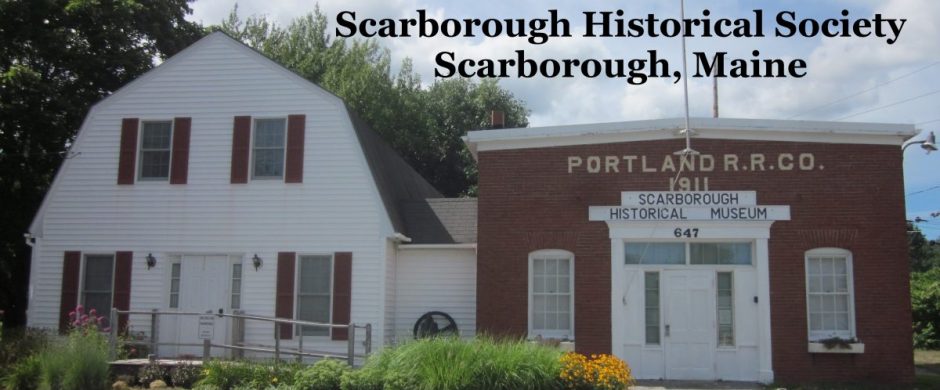
The McCullum (Hunnewell) House: Scarborough’s Red House and Its Legacy

Sitting at the triangle of Black Point Rd, Winnocks Neck Rd, and Old County Rd, the historic McCullum (Hunnewell) House—also known as the “Red House”—holds a special place in the town’s story. Believed to be one of the oldest houses in Cumberland County, it was long associated with the Hunnewell family, particularly “One-Arm” Roger Hunnewell, a veteran of Louisburg.. This 1915 news article from the Narragansett [Times] explores the house’s construction, its changing ownership, and its connection to Captain Roger Hunnewell, who was killed in 1703 during a skirmish at Black Point. The “Red House” still stands as a symbol of Scarborough’s past, conflicts, and early Scarboro history.


The Narragansett [Sun][i] ___ber 16, 1915

OLD MAINE HOUSES
Number Six
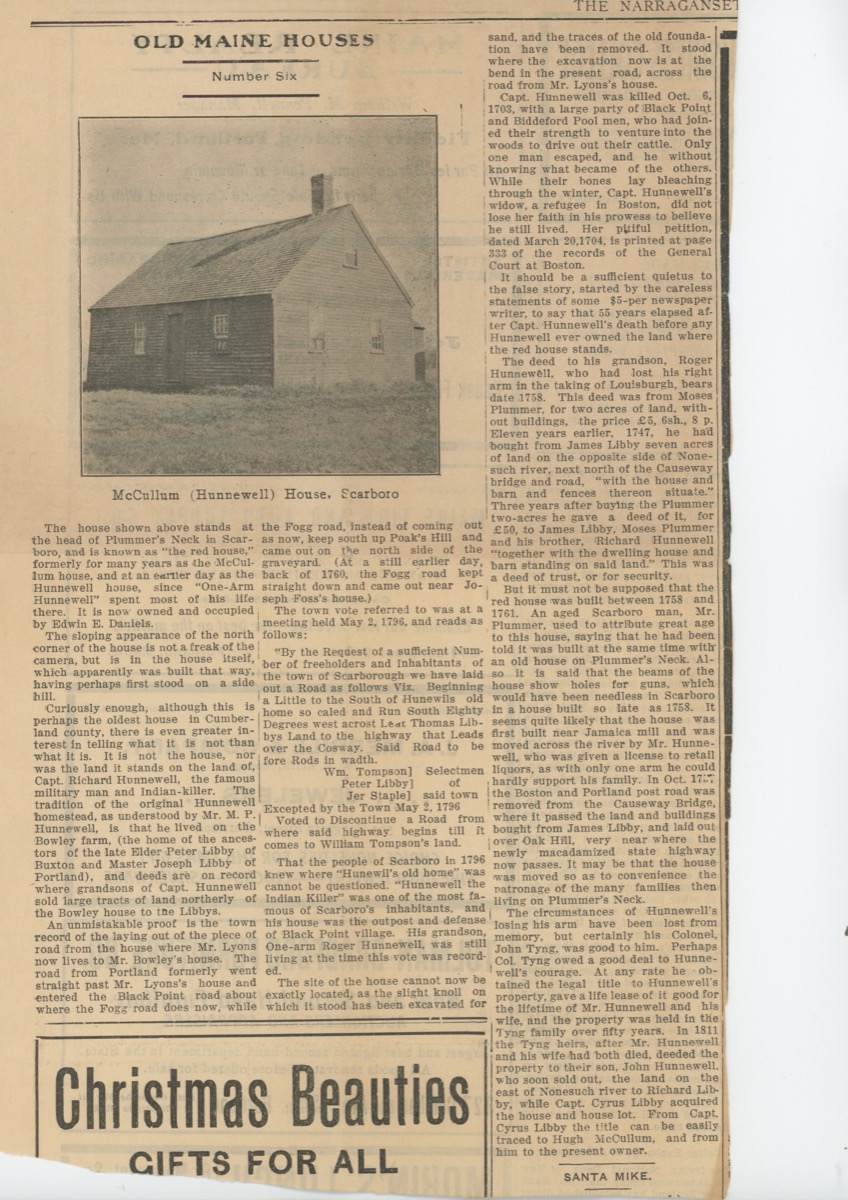
McCullum (Hunnewell) House, Scarboro

The house shown above stands at the head of Plummer’s Neck in Scarboro, and is known as “the red house,” formerly for many years as the McCullum house, and at an earlier day as the Hunnewell house, since “One-Arm Hunnewell” spent most of his life there. It is now owned and occupied by Edwin E. Daniels.

The sloping appearance of the north corner of the house is not a freak of the | camera, but is in the house itself,1 which apparently was built that way, having perhaps first stood on a side hill.

Curiously enough, although this is perhaps the oldest house in Cumberland county, there is even greater interest in telling what is not than what it is. It is not the house, nor the land it stands on  with the house on the land, of the noted Hunnewell, the famous old military man and Indian-killer. The evidence of the wonderfully complete manuscript records of the Mr. M. P. Hunnewell, is that he lived on the1 Bowley farm, (the home of the ancestors of the late Elder Peter Libby of Buxton and Master Joseph Libby of Portland), and deeds are on record where grandsons of Capt. Hunnewell sold large tracts of land northerly of the Bowley house to the Libbys.

An unmistakable proof is the town record of the laying out of the piece of road from the house where Mr. Lyons now lives to Mr. Bowley’s house. The road from Portland formerly went straight past Mr. Lyons’s house and •entered the Black Point road about where the Fogg road does now, while

[Column 2]

the Fogg road, instead of coming out as now, kept south up Poak’s Hill and came out on the north side of the graveyard. (At a still earlier day, back of 1760, the Fogg road kept straight down and came out near Joseph Fogg’s house.)

The town vote referred to was at a meeting held May 2, 1796, and reads as follows:

“By the Request of a sufficient Number of freeholders and Inhabitants of the town of Scarborough we have laid out a Road as follows Viz. Beginning a Little to the South of Hunwells old home so called and Run South Eighty Degrees east across Leat Thomas Libbys land to catch and join that leads over the Causeway. Said Road to be four Rods in width.”

Wm. Tompson ] Selectmen
Peter Libby     ]       of
Per Stalely  ]   said town

Excepted by the Town May 2, 1796
Voted to Discontinue a Road from where said highway begins till it comes to William Thompson’s land.

That the people of Scarboro in 1796 knew where “Hunewell’s old home” was and not to be disputed is shown. The Indian Killer was one of the most famous of Scarboro’s inhabitants, and the house he had lived in was within one half mile of Black Point village, and from “One-Arm” Roger Hunnewell, who was living at the time this vote was recorded.

The site of the house cannot now be exactly located, as the slight knoll on which it stood has been excavated for

[Column 3]

sand, and the traces of the old foundation have been removed. It stood where the excavation now is at the bend in the present road, across the road from Mr. Lyons’s house.

Capt. Hunnewell was killed Oct. 6, ; 1703, with a large party of Black Point ; and Biddeford Pool men, who had joined their strength to venture into the woods to drive out their cattle. Only one man escaped, and he without I knowing what became of the others. I While their bones lay bleaching , through the winter, Capt. Hunnewell’s I widow, a refugee in Boston, did not lose her faith in his prowess to believe he still lived. Her pitiful petition, dated March 20, 1704, is printed at page 333 of the records of the General Court at Boston.

It should be a sufficient quietus to the false story, started by the careless statements of some $5-per newspaper writer, to say that 55 years elapsed after Capt. Hunnewell’s death before any Hunnewell ever owned the land where the red house stands.

The deed to his grandson, Roger Hunnewell, who had lost his right arm in the taking of Louisburgh, bears date 1758. This deed was from Moses Plummer, for two acres of land, without buildings, the price £5, 6sh., 8 p. Eleven years earlier, 1747, he had bought from James Libby seven acres of land on the opposite side of Nonesuch river, next north of the Causeway bridge and road, “with the house and barn and fences thereon situate.’’ Three years after buying the Plummer two-acres he gave a deed of it, for £50, to James Libby, Moses Plummer and his brother, Richard Hunnewell “together with the dwelling house and barn standing on said land.” This was a deed of trust, or for security.

But it must not be supposed that the red house was built between 1758 and 1761. An aged Scarboro man, Mr. Plummer, used to attribute great age to this house, saying that he had been told it was built at the same time with an old house on Plummer’s Neck. Also it is said that the beams of the house show holes for guns, which would have been needless in Scarboro in a house built so late as 1758. It seems quite likely that the house was first built near Jamaica mill and was moved across the river by Mr. Hunnewell, who was given a license to retail liquors, as with only one arm he could hardly support his family. In Oct. 1757 the Boston and Portland post road was removed from the Causeway Bridge, where it passed the land and buildings bought from James Libby, and laid out over Oak Hill, very near where the newly macadamized state highway now passes. It may be that the house was moved so as to convenience the patronage of the many families then living on Plummer’s Neck.

The circumstances of Hunnewell’s losing his arm have been lost from memory, but certainly his Colonel, John Tyng, was good to him. Perhaps Col. Tyng owed a good deal to Hunnewell’s courage. At any rate he obtained the legal title to Hunnewell’s property, gave a life lease of it good for the lifetime of Mr. Hunnewell and his wife, and the property was held in the Tyng family over fifty years. In 1811 the Tyng heirs, after Mr. Hunnewell and his wife had both died, deeded the property to their son, John Hunnewell, who soon sold out, the land on the east of Nonesuch river to Richard Libby, while Capt. Cyrus Libby acquired the house and house lot. From Capt. Cyrus Libby the title can be easily traced to Hugh McCullum, and from him to the present owner.


ENDNOTES


[i] The clipping says the paper is “The Narraganset,” but the remainder of the paper is cut off. Ads on the back page side are for Portland, Maine businesses.  My query of ChatGPT indicated “The Narragansett Sun was published in Portland, Maine, from 1892 to 1916. This weekly newspaper served the local community during that period.”

The back side also provides a date of “BER 16, 1915” suggesting it was published in the Fall of 1915.
Posted in Genealogy, Homes, Scarborough History | Tagged , , , , , , , , | Comments Off on The McCullum (Hunnewell) House: Scarborough’s Red House and Its Legacy

A Soldier’s Farewell: A Glimpse into Civil War Anxieties

2024.12.04b

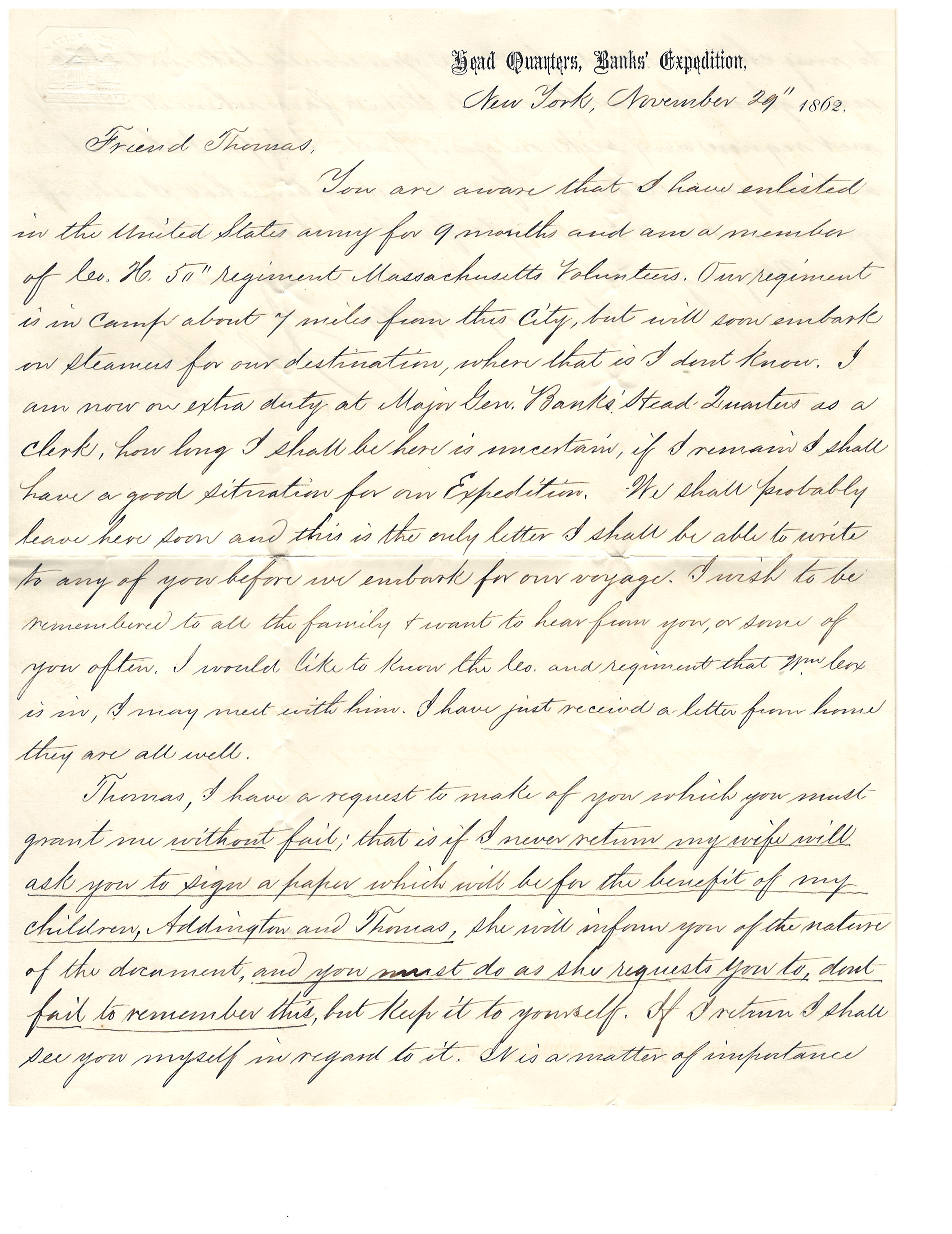
On November 29, 1862, John Hale, a soldier in the Union Army, penned a letter to his friend Thomas. Hale, a member of Company H, 50th Regiment Massachusetts Volunteers, was stationed at Major General Banks’ Headquarters in New York, serving as a clerk. This letter, written amidst the uncertainty of the Civil War, offers a poignant glimpse into the personal sacrifices and anxieties faced by soldiers and their families.

Hale’s regiment was encamped seven miles from New York City, preparing for embarkation to an unknown destination. He anticipates leaving his clerical duties soon and acknowledges that this letter might be his last opportunity to communicate before his departure. The immediate uncertainty of his future and the prospect of separation from loved ones are palpable.

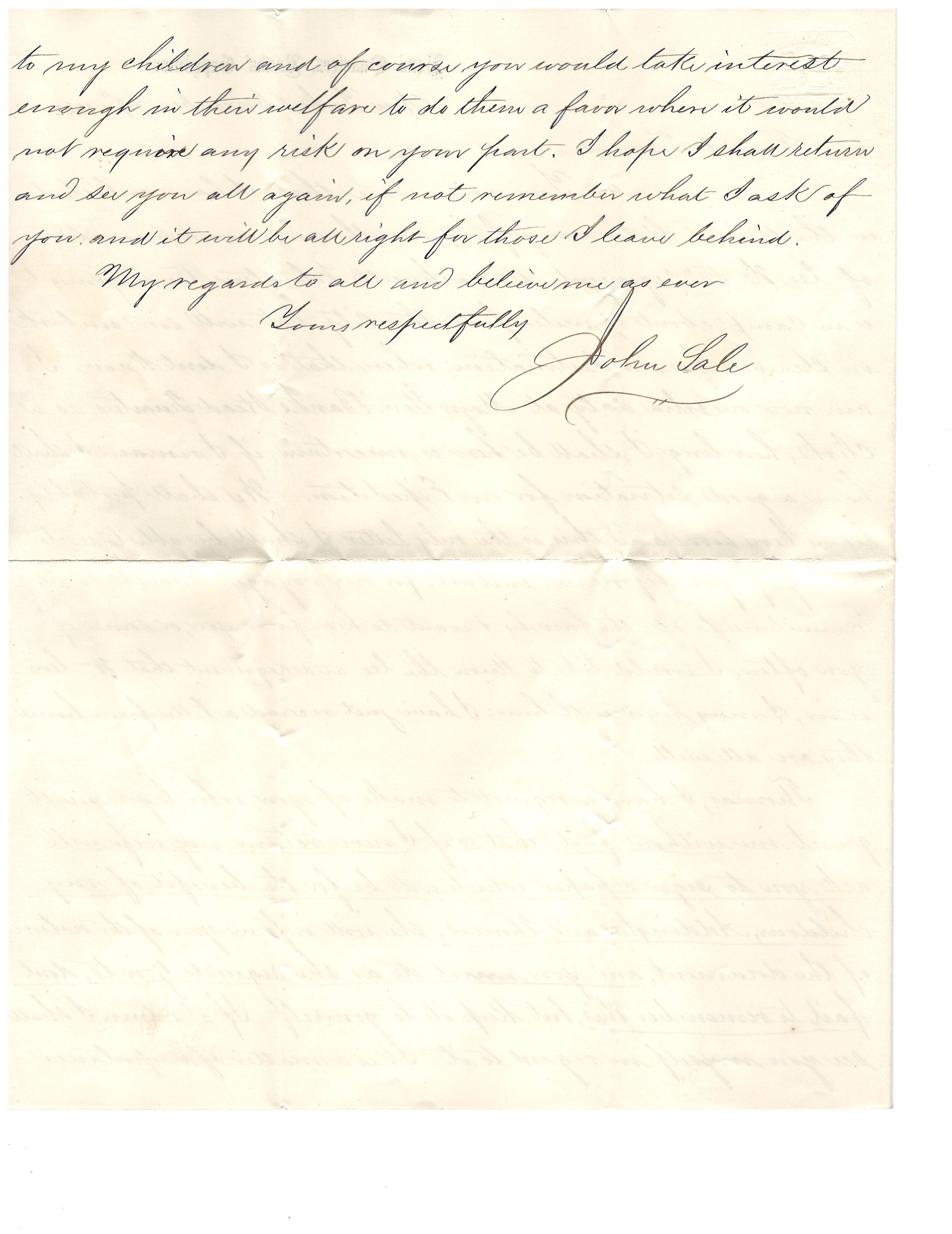
The letter also reveals Hale’s deep concern for his family, especially his children, Eddington and Thomas. He makes a heartfelt request to his friend Thomas: should he not return from the war, Thomas is to sign a document for the benefit of his children, the specifics of which his wife will explain. This plea underscores the profound sense of duty and foresight many soldiers felt regarding their families’ well-being in their potential absence. It’s a stark reminder of the ever-present shadow of death that loomed over those serving in the war.

Hale’s letter is a powerful testament to the personal toll of the Civil War. It captures the blend of duty, fear, and enduring love that characterized the experiences of many soldiers. It also provides a unique window into the logistical realities of military life—the constant movement, the unknown destinations, and the limited communication. This single document serves as a moving artifact, connecting us directly to the human stories behind the grand narrative of the Civil War.


Transcription [by Google Gemini – 31 May 2025]


Head Quarters, Banks’ Expedition.
New York, November 29″ 1862.

Friend Thomas,

Image if original letter

You are aware that I have enlisted in the United States army for 9 months and am a member of Co. “H” 50″ Regiment Massachusetts Volunteers. Our regiment is in camp about 7 miles from this City, but will soon embark on steamers for our destination, where that is I don’t know. I am now on what duty at Major Gen. Banks’ Head Quarters as a Clerk, how long I shall be here is uncertain, if 1 or 2 months I shall have a good situation for our Expedition. I’ll probably leave here soon and this is the only letter I shall be able to write to any of you before we embark for our voyage. I wish to be remembered to all the family. I want to hear from you, or some of you often. I would like to know the Co. and regiment that you box is in, I may meet with him. I have just received a letter from home they are all well.

Thomas, I have a request to make of you which you must grant me without fail, that is if I never return my wife will ask you to sign a paper which will be for the benefit of my children, Eddington and Thomas, she will inform you of the nature of the document, and you must do as she requests you to, don’t fail to remember this, but keep it to yourself. If I return I shall see you myself in regard to it. It is a matter of importance

Image of original letter.

——————————

to my children and of course, you would take interest enough in their welfare to do them a favor when it would not require any risk on your part. I hope I shall return and see you all again, if not, remember what I ask of you and it will be all right for those I leave behind.

My regards to all and believing as ever
Yours respectfully
John Hale

[Transcription by Google Gemini – 31 May 2025]


This blog post was generated with the help of Google Gemini.

Posted in American History, Civil War, History, Military | Tagged , , , , | Comments Off on A Soldier’s Farewell: A Glimpse into Civil War Anxieties

ME H&GR at Internet Archive. 

Interested in Scarborough History or your Maine Ancestors? The Maine Historical And Genealogical Recorder is a treasure trove of information about the King family (Dunstan), Births, Marriages, and Deaths of members of the First Congregational Church (Black Point), early Scarborough land grants, and early Scarborough settlers. See:

The Maine Historical and Genealogical Recorder, edited by S. M. Watson – Nine Volumes in Three – Volumes 1-III (1884, 1885, & 1886) is available at the Internet Archive.

A search for “Scarboro” results in 80 results; “Scarborough” results in 73 results. (Always be sure to search for both spellings.)

Articles include:

  • The King Family of Maine.
    • Records of the First Congregational Church in Scarborough, ME (appears in several volumes and issues).
      • Recollections of Gen. King, First Governor of Maine.
    • Scarborough Land Grants, 1665.
    • The Mansion and Tomb of Richard King, of Scarborough.
    • Oakman Family.
    • Historical Sketches in Scarborough.

Be sure to search for “Index.” There, you can find specific surnames and pages the surname appears on. For example, the surname “Libby” appears on 31 pages in Volume I alone.

Posted in Churches, Genealogy, History | Tagged , | Comments Off on ME H&GR at Internet Archive. 

Pages Updated – March 2025

Library | Education | Early Scarborough High Schools – 1877-1926

1923

Students Scarborough High School classes of 1923-1926. Includes: Mildred Bowley, Emma Oleson, Marion Peterson, Ada Wentworth, Gladys Pooler, Ina Sampson, Tena McKenney, Margaret Urquhart, Lois Pillsbury, Harold Bennett, Maurice Plowman, Clayton Sargent, Helen Bowley, Helen Lincoln, Molly Pillsbury, Helen Fenderson, Amy Wellman, Agnes Lund, Mabel Libby, Priscilla Googins, Helen Libby, Bertha Westman, Ruth Hodgman, Hazel Morse, Aubrey Lincoln, Walter Sargent, Raymond Sparrow, Walter Nielsen, Myrtle Hanscom, Dot Shaw, Martha Pillsbury, Elinor Lary, Hazel Merry, Lucy Knight, Lucinda Mitchell, Norman Thurston, Bud Libby, Bill Googins, Pete Storey, Walter Fredericks, Fred Skillings, Clyde Harmon, Stephen Larabee, Max Emmons, Frank Mitchell, Clarence Peterson, J. Ross Sherwood, Miss Stevens, Miss Bryantkoter, Mrs. Libby, Clarence Nielsen, Chris Anderson, Clark Libbey, Mr. Bessey, Lawrence Harmon, et al.

Library | Education | High Schools

Class of 1956

SHS PTA Presents “The Shoemaker and The Slipper” 1956-06-02

Class of 1958

SHS PTA Presents “Dancingly Yours” – 1958-05-27

Class of 1959

SHS PTA Presents – “Away We Go” – 1959-05-28

Posted in Education | Tagged , , , , | Comments Off on Pages Updated – March 2025

Pages Updated – February 2025

Library | Videos

Scarborough Audubon Center by Linda Woodward

This program dives into the exciting world of the Scarborough marsh, looking at animals, people, and how the land has changed. It examines how humans have used the marsh and how the marsh center itself came to be. It also looks at how the diversity of animals has changed over the years, noting what species have left the marsh and what animals have developed there. Some species have recovered and now are in abundance, while others have become endangered. The marsh is changing due to clim

Posted in Organizations, Videos | Comments Off on Pages Updated – February 2025