The Southgate House has been a landmark of Dunstan Village, Scarborough, Maine, since the early 1800s. Built around 1805–1810 by members of the Southgate family, the house served as an inn and tavern for travelers along the Portland Road—today’s U.S. Route 1. The Southgates were an influential family in Scarborough’s early history, with Dr. Robert Southgate playing a prominent civic and religious role.
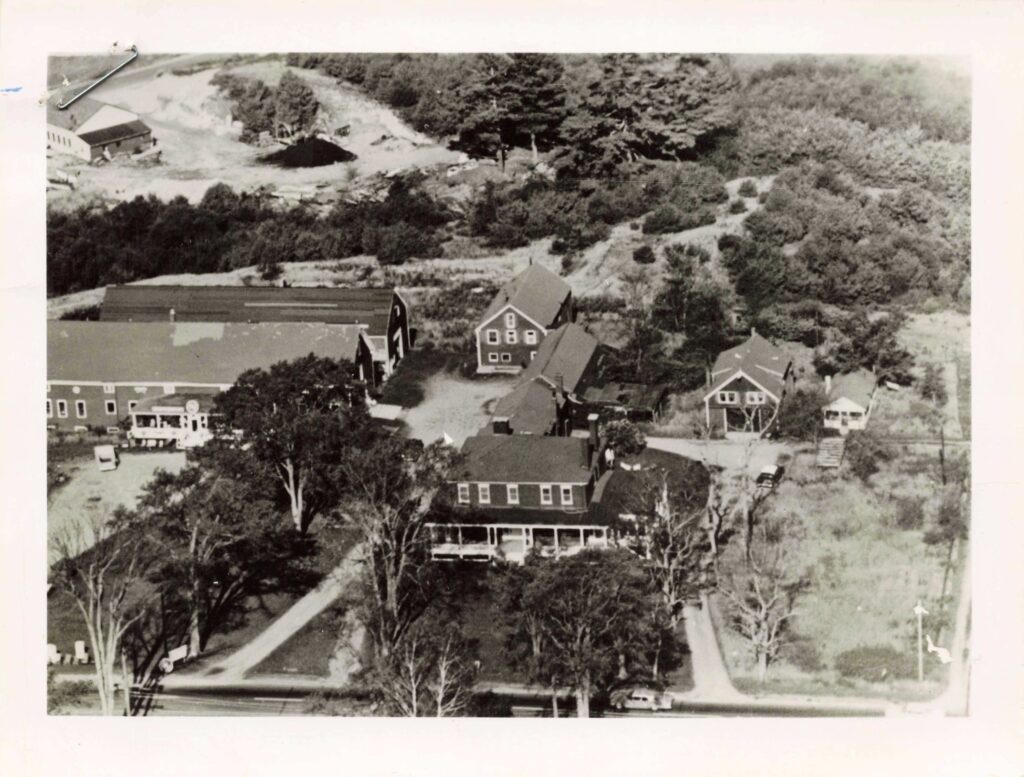
Southgate House (Aerial) 2025.16.11b
This aerial photo, likely taken in the late 1950s or early 1960s, shows the house’s distinctive wrap-around porch and the surrounding barns and outbuildings that once supported its use as both a home and a working farm. For generations, the Southgate House stood as a welcoming stop for locals and visitors alike, symbolizing the village’s long tradition of hospitality and community life.
The building remains a reminder of Dunstan’s rich past and the families who shaped Scarborough’s history.
Today, the historic Southgate House has been repurposed and now serves as affordable housing managed by Avesta Housing. The property—formerly including the original farmhouse and barns—was fully redeveloped between 2015 and 2018 into a 38-unit residence for individuals and families earning between 50%–60% of the area median income [Source].
The centerpiece, the historic 1805 brick farmhouse built by Dr. Robert Southgate, underwent internal renovation to include eight apartments, while additional apartment buildings were constructed on the surrounding three-acre parcel [Source]. This development was honored with a 2021 Charles L. Edson Tax Credit Excellence Award for its successful fusion of historic preservation and affordable housing [Source]
The Southgate House no longer operates as a farm or inn. Instead, it provides community-focused, income-restricted rental housing, blending its rich history with meaningful contemporary use.
(This article was developed with the help of ChatGPT and edited using Grammarly.)
Knight’s Furniture was once a beloved family-run business at the heart of Dunstan Village in Scarborough, Maine. Located on U.S. Route 1, the store served generations of local families with quality furniture and home goods, all within a converted barn that became a familiar landmark.
At a time when Dunstan Corner was a bustling stop along the main coastal route, Knight’s was part of a thriving village economy that included small shops, gas stations, and restaurants. Many remember stopping in to browse sturdy bedroom sets, dining tables, and living room pieces.
As Scarborough grew and larger retail stores changed the furniture business, Knight’s eventually closed, but its barn and the memories live on in the stories of residents who furnished their homes through this trusted local store.
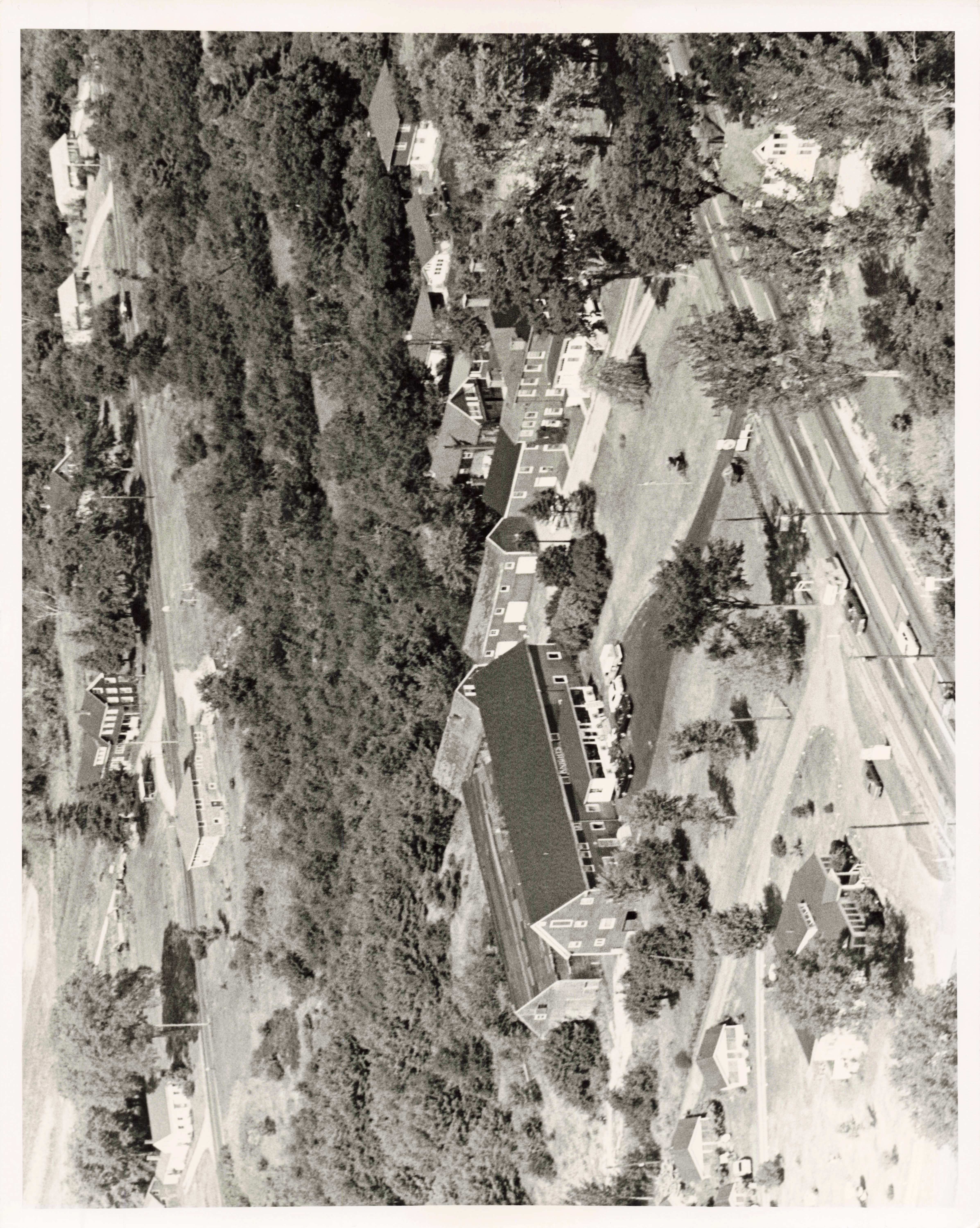
Photo: Knight’s Furniture (Aerial) 2025.16.13)
This aerial view, taken around 1960, shows Knight’s Furniture at its peak — a reminder of Dunstan village’s role as a vital hub in Scarborough’s commercial past.
Today, this area, 581 US Route 1, is home to Suburban Home Outfitters and Gurley Antiques Gallery, “A Quality Multi-Dealer Shop.”
(This article was developed with the help of ChatGPT and edited using Grammarly.)
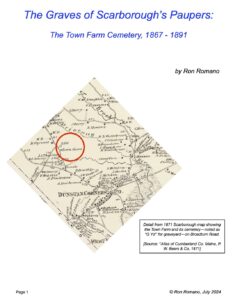
Ron Romano’s The Graves of Scarborough’s Paupers: The Town Farm Cemetery, 1867–1891 offers a moving, thoroughly researched account of Scarborough’s 19th-century approach to caring for its poorest citizens. When the town purchased the Brackett Farm in 1867, it became a self-sustaining alms house for residents who were unhoused, mentally or physically unwell, or otherwise unable to care for themselves. A cemetery was established onsite, where at least 19 individuals were interred, including Deborah Dyer and Priscilla Burnham. Romano reconstructs lives often forgotten, using town reports, census data, vital records, and cemetery surveys. He details the farm’s operations, changes in overseers, and the transition of remains from the farm’s cemetery to Dunstan Cemetery around 1891. The cemetery and farm, once central to Scarborough’s welfare efforts, are now lost to development, but through this paper, their history and the names of those buried there are spoken again and remembered.
Topics include:
The 1821 Town Warrant
Scarborough’s Earliest Annual Reports
1850 & 1860 US Censuses for Scarborough
“The Poor of the Town Should Find a Home”
The Sad End of Daniel Richards
More Than Four Decades of Care for Samuel Snow
The Brackett Farm becomes the Town Farm
The First Residents of the Farm
Deborah Dyer: First to Be Buried at the Town Farm Cemetery
The Farm’s Second Keepers
Following the Paper Trail
The Whereabouts of Samuel Plaisted’s Remains
Through the 1870s
Through the 1880s
More Burials at the Town Farm Cemetery
Into the 1890s
The Longest-term Resident of the Farm
Curiosities in the 1892 Town Report
Checking Records Through 1899
The Overworked Matron
The End of the Farm
Lingering Questions…
…and Summary Thoughts
The Paupers’ Field at Dunstan Cemetery
There are also four appendices:
Appendix A: Those who died at the Town Farm, 1867 to 1891, and arebelieved to have been interred at the farm cemetery.
Appendix B: Overseers of the Town Farm, 1867 to 1900(As recorded in Town Annual Reports).
Appendix C: Number of Residents at the Town Farm, 1867 to 1900(some years unreported).
Appendix D: Others who died while under the town’s care and may beburied at Dunstan Cemetery’s paupers’ field.
Ron Romano’s Letting Out the Poor uncovers the mid-19th-century system of poor relief in Scarborough, Maine, through the logbook of Ebenezer Libby, Overseer of the Poor from 1857–1867. The paper explains how impoverished residents were “let out” to townspeople—essentially placed in homes where their room and board would be covered by the town in the lowest possible amount—highlighting the lives of individuals such as Augusta Lowell, Priscilla Burnham, and Theodore Libby. Romano contextualizes this practice within broader social norms and evolving attitudes toward poverty. The paper preserves the humanity of the town’s forgotten residents and includes a full transcription of Libby’s detailed log entries.
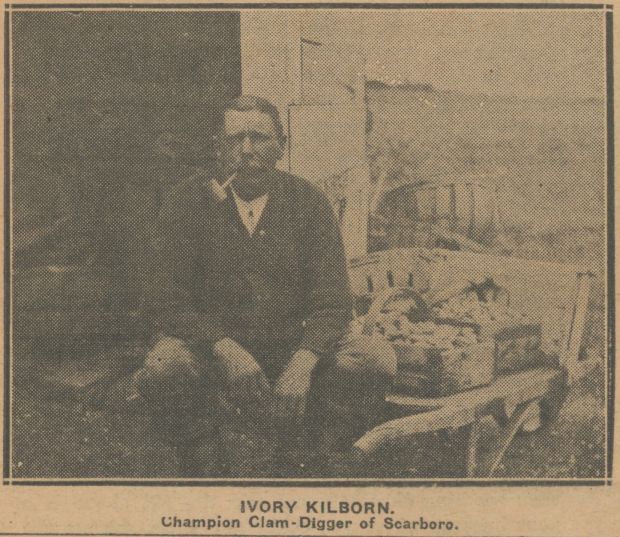
Nestled along the scenic Cape Shore Drive near Scarborough’s Spurwink River stood a humble shack with a simple sign: “Clams.” For over a decade, Ivory Kilborn lived and worked there, earning a reputation as a master digger and shucker of clams—the finest clams that the clean, sandy flats of the Spurwink could provide. In an era when coastal clamming was both a livelihood and a tradition, Kilborn embodied the independence, hard work, and community spirit that defined life in Scarborough. This article from the early 20th century provides a vivid glimpse into Kilborn’s daily life, his booming clam business, and the enduring charm of Scarborough’s shoreline culture.
(This article was taken from the Lewiston Journal, Magazine Section, front page, April 4, 1925.)
The Life of a Clam Digger on the Spurwink
By Alfred Elden
[Written for the Lewiston Journal.]
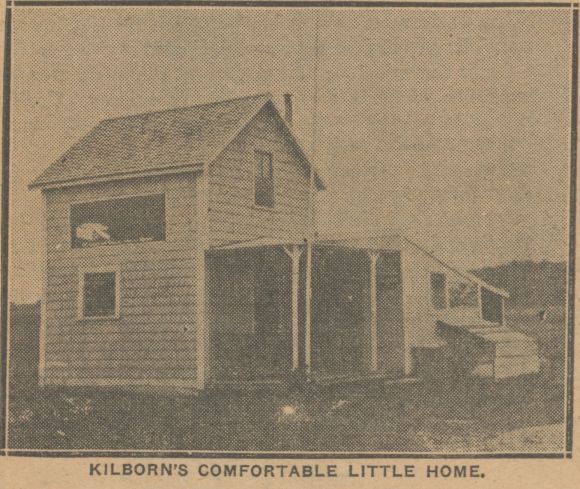
Just before coming to ‘Mitchell’s erstwhile famous roadhouse, on the popular Cape Shore Drive a house closed, this year, but noted for half a century for its shore dinners, down thru the fields toward the glistening Spurwink River, there stands a little building. There is a grassy driveway to it from the road and at the entrance a plain sign in black and white bears the single word “Clams.” But that sign means a lot to these who have made the acquaintance of Ivory Kilborn, the proprietor and occupant of the little house. It means that there they can get the real thing in clams.
And to the visiting motorist there is something about that sign that gives him pause and finally induces him to turn his car into the driveway. The entire picture is suggestive of the fact that here one may find clams that are clams. If it is low tide there is the clean, sandy bed of the Spurwink River, a shimmering, winding estuary, which twists itself around a wooded peninsula a half mile distant and then merges its waters with those of the open Atlantic at the very easterly end of Higgins Beach.
Here, surely, one will find clams free from the taint of sewer and rubbish infected flats, clams of the variety of those that generations ago made Scarboro famous.
And thousands upon thousands who have bought clams of Ivory Kilborn have found their expectations fully realized. For twelve years summer and winter this clam man has lived most of the time absolutely alone in his little house. It is as scrupulously clean as the inside of one of Uncle Sam’s lighthouses, for Kilborn has the time and ‘the inclination to keep things neat. There is a small living and sleeping room combined, altho during the day the couch bed gives no indication of the use to which it is put at night. There is a smaller kitchen and, until this year, that was all. Seeing the possibility or augmenting his clam business with a side line Kilborn added another room where he keeps cool drinks, cigars and cigarets. He also changed the location of his front door and enlarged the piazza. In a little shed-like inclosure at the rear he shucks out his clams.
“Yes,” admitted Kilborn to a question, “I have lived here all alone for a dozen years. Get lonesome in winter? Bless you, no! There are plenty of neighbors back up the road there. I call on them and they call on me. We play cards, listen to talking machines and even radio just as you folks in the city do. As long as we get a decently open winter I don’t mind it. But one like we had two years ago! Whew! I think I’d move into town if I thought we would have another one. Everything was frozen up, even the river here clear to its mouth and it is some cold winter when it will do that. Couldn’t clam, couldn’t do anything except shovel a path to the road, pile fuel on the fire and read and smoke. This winter wasn’t so bad and last winter—why, a man could work half the time in his shirt sleeves. I dug clams almost every day and sent them into market by a neighbor who called for them.
Asked where he got his clams and how many he dug brought forth some interesting information from Kilborn.
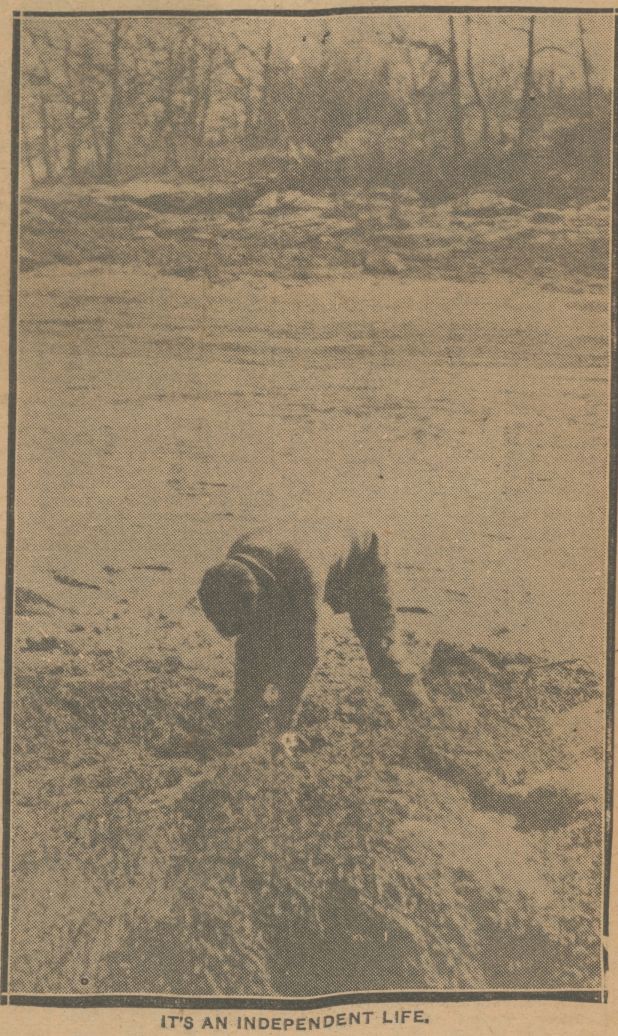
“I dig ’em all from a point opposite Mitchells to the mouth of the river. Not more than a quarter of a mile, I should say. Getting scarce? Bless you, no. I been digging ’em winter and summer for 12 years and I don’t see but there are just as many as there ever were. I don’t plan to take anything less than two and a half inches and most of them go bigger than that. They tell me and f’m my observation I guess it’s right, that a clam will grow from the seed to full size in about three years. And there’s a lot of clams in the Spurwink here.
“They really are wonderful good ones, too. Better than those they get out of the Nonesuch River beyond here, meatier and a little sweeter, I think.”
In reply to a query as to whether he ever sold as much as a bushel a day to passing automobllists, Kilborn looked up quizzically and then, seeing that the question was asked in good faith, laughed as he answered:
“Of course this isn’t a clam factory but I average more than five bushels a day and on Sundays I sell between twenty and thirty bushels. Dig ’em alone? Generally, altho I’ve got a feller helping me during the rush months last summer. But I’ve dug from four to six bushels lots of days. A good many folks buy clams for steaming but there’s also a bunch of ’em likes ’em fried or made into stews so I have to do a lot of shuckin’. A bushel of clams such as I get will shuck out just twelve full, solid quarts ”
A little mental computation here Indicates possibilities in Kilborn’s industry. Accepting his minimum of five bushels a day. Supposing he shucks out half of that amount. If each bushel nets 12 quarts of clams that would mean six quarts of shucked bivalves per bushel or thirty quarts a day. At 40 cents a quart that would total $12. Then there are the other half of the day’s dig sold for steaming at 40 cents a peck, four pecks to the bushel, and Sundays when twenty to thirty bushels are sold, and—but what’s the use! Kilborn is naturally not giving out many statistics, but living expenses can’t be very great in the little house and the upkeep of a small skiff and a few clam rakes and baskets isn’t overwhelming. So it is fairly sure that he isn’t worrying about any wolf sneaking across the flats and in thru his back door.
Possibly this line of reasoning is what induced two yeggs to sneak up on him one dark night two years ago, knock him unconscious and escape undetected with his roll of more than $100. That taught him not to keep money in the house with him for its location is just far enough from the neighbors so as absolutely to isolate him at night.
“If I cared for gunning I could get plenty of black ducks, old squaws, coots, sheldrakes, whistlers and the other varieties in the fall,” said Mr. Kilborn. “Right across the river there, back of the woods is Great Pond. That’s where the Great Pond Gun club is. Lot of city folks from Boston and New York own it and have the rights to the shooting. They get a heap of birds. It’s a wonderful place, too, for pond lilies. One chap makes a pretty penny during the summer getting lilies and taking them in to Portland where he sells them on the street or around at the houses.”
Not such a bad life in summer, for the little clam house really occupies a charming site and in fair weather every few minutes brings customer-vistors. And even in winter, unless, as Kilborn said, it happens to be too bitter, it might be much worse. After all this clam man is absolutely independent and making all he needs. What more can mortal ask?