Transportation Through the Years – Part 3 of 4

Text by Bruce Thurlow

Images from Scarborough Historical Society,
Rodney Laughton and Joseph W. Sno

Aviation: When Flight Was Still a Novelty

Scarborough Airport

Air Meet at Portland Airport in Scarborough, 1928

Air Meet at Portland Airport in Scarborough, 1928

Scarborough airport, actually the Portland Airport, was dedicated on 28 and 29 September 1928. An air show complete with parachute jumpers was held to commemorate the occasion and many flying greats were guests. A booklet, Portland Air Meet, with pictures of the different types of planes present was available that weekend at the cost of 10 cents. Land for the airport was purchased from Lida Libby and George Eastman. The tract was slightly north of the Portland, Saco & Portsmouth Railroad tracks and the western edge bordered the marsh. It is now the site of Scarborough Industrial Park.

In 1929 Curtis Wright Corporation built a nearby log cabin intended as a barracks for a summer flight school. This school, which opened on 8 April 1930, was the first in the nation to offer a campus-like flying school. The first class attended from 20 June until 14 September 1930 and had approximately 120 college men from all parts of the country.(1) At the time it was said that Portland would be ready to take its place among the great commercial airports of the world. Locally owned and developed entirely of local capital, the Portland Airport at Scarborough was deemed adequate for any commercial purpose.

Aerial View of Portland Airport in Scarborough, ca. 1927

Aerial View of Portland Airport in Scarborough, ca. 1927

Famous aviators and commercial lines came to the Scarborough Airport. Charles Lindbergh attempted to fly into the airport in July 1927 while it was under construction, but dense fog prevented him from landing. After an unsuccessful attempt the following day, he landed instead on the beach at Old Orchard Beach. Lindbergh did visit Scarborough Airport that day, but via a motorcade on his way to Portland. A year later, he made his historic solo Atlantic crossing. In 1934, Amelia Earhart paid a visit to this airport as part of a promotional plan; she had been highly in favor of commercial air service. The Boston & Maine Airways had just inaugurated its Maine service.(2)

Image of Airplanes on Beach, Scarborough, 1921

Airplanes on Beach, Scarborough, 1921

Within ten years of opening, the Scarborough (Portland) Airport was inadequate for the increasingly larger, more powerful aircraft. Since there was insufficient space for expansion in Scarborough, airport operations were relocated to Stroudwater, location of today’s Portland International Jetport. The Scarborough complex was used for private enterprises, such as air shows and flying schools. Fire destroyed the hangar in the late 1940s and no trace of the airport remains today.

Port-of-Maine Airport

Portland Flying Service, Scarborough, ca. 1946

Portland Flying Service, Scarborough, ca. 1946

After the blackout restrictions of World War II were lifted, the Port-of-Maine Airport opened at a site off Pleasant Hill Road. Flying schools and service operations continued into the 1960s.(3)

Remembrance

Joseph Snow, a Scarborough resident, was very active in early aviation. He was a master mechanic who built his own airplane, and he also worked for a Mr. Jones who owned an airplane hanger in Old Orchard Beach. I remember my mother telling me about the early days of aviation when it was quite common for planes to take off and land on the beaches. The seven-mile stretch of beach from the easterly tip of Pine Point through Old Orchard Beach to Hill’s Beach in Biddeford was often used. I’ve had frequent conversations with Joseph about his early experiences in aviation.(4)

Source Notes

  1. Scarborough Historical Society Collection: Aviation
  2. See note 1 above.
  3. https://www.scarborough.me.us/commserv/trails/history.ht

Part 1Part 2Part 3Part 4

Posted in Pine Point, Pleasant Hill, Transportation | Tagged , , , , , , | Comments Off on Transportation Through the Years – Part 3 of 4

Transportation Through the Years – Part 2 of 4

Text by Bruce Thurlow

Images from Scarborough Historical Society,
Rodney Laughton and Joseph W. Sno

Trolleys: The Electrics Come to Town

Open Air Trolley, Scarborough, ca. 1910

Open Air Trolley, Scarborough, ca. 1910

As trains transported people and freight to Portland, Boston and beyond, the trolleys provided easy mobility within the Greater Portland area. Beginning in the 1860s, the Portland Railroad Company operated horse-drawn cars on rails that ran through Scarborough and other area towns. During the winter months when there was snow, sleigh cars replaced the horse cars. Some time after Portland became electrified in the 1880s, the horse cars were converted to electrics or “trolleys.” By the early 1900s, electricity came to Scarborough and trolley service soon followed. Like the railroads, trolley lines connected with one another, allowing passengers to travel greater distances. People could live in the smaller towns outside of Portland, yet be able to work or shop in the city. The trolleys also allowed residents to visit area amusement parks and beaches for pleasure at an affordable cost. For thirty years, the Portland Railroad Company provided Scarborough with frequent and convenient rail service to Portland, Old Orchard Beach, and Saco following what is now Route 1.(1)

Trolley at Dunstan, Scarborough, ca. 1910

Trolley at Dunstan, Scarborough, ca. 1910

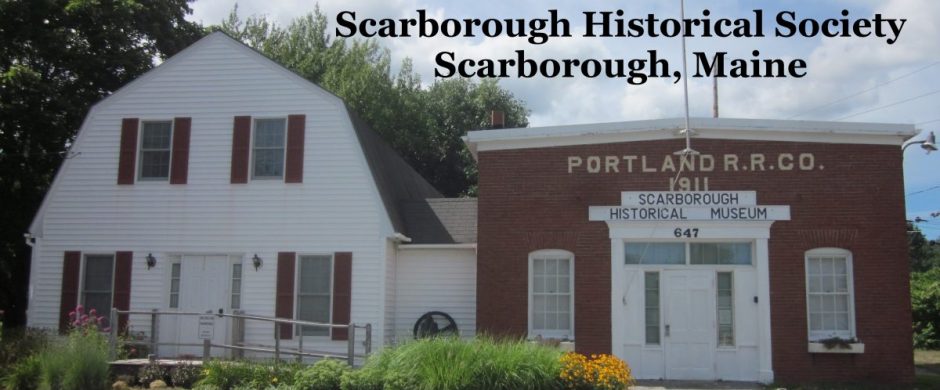
On 24 July 1902, Scarborough residents celebrated the opening of the connection of the rails of the Biddeford & Saco Railroad Company to those of the Portland Railroad Company.(2) Scarborough would have trolley service at last! The connection was initially planned for completion in 1901, but difficulties in constructing a bridge over Stuart’s Brook delayed the anticipated opening. The track from Dunstan to Old Orchard Beach opened the following year on 4 July 1903. The popular tourist spot was finally connected to Portland and its railroad station. There had been a challenge, however, constructing the trestle over the marsh, Foxwell’s Brook and the Eastern Railroad. An S-shaped trestle was built to correct both a dangerous curve and crossing grade for the railroad.(3) Batteries that powered the trolleys were recharged and maintained at a power station in Dunstan. The generator plant is today’s Scarborough Historical Society and Museum building.(4)

Turnouts, where trolleys could stop and pick up or discharge passengers, were located at Sweetsers, just south of the Nonesuch River; Oak Hill; Scottow, just before the marsh; Southgate, on the Portland end of Dow’s farm; Dunstan, near the Dunstan trolley barn; and Bryants, the Scarborough-Saco town line. Trolleys carried both passengers and freight. Relatively open passenger cars were used during summer months, and closed cars were used during the remaining months. Most of the freight cars traveled over the Saco Division to Old Orchard Beach and Biddeford where there was a shed for interchange with the Atlantic Shore Railroad to York County points.(5)

Trestle over B & M on the Old Orchard Division, ca. 1930

Trestle over B & M on the Old Orchard Division, ca. 1930

Rising operating costs and increasing use of automobiles weakened the financial situation of the trolley lines. Although steps were taken through the Depression of the early 1930s to reduce losses, such as abandoning some lines, the trolley system never recovered. People were out of work or on a wage scale that precluded any extra pleasure trips, and fewer people were riding the trolley to Portland for shopping. Despite attempts to save the lines, all Greater Portland trolleys were gone by 1941.

Source Notes

1. Charles Heseltine, Trolley Car Era, Scarborough, Maine 1903-1932 (Scarborough Historical Society, 2006)
2. Susan Dudley Gold, ed., Scarborough at 350: Linking the Past to the Present (Scarborough, ME: Friends of the 350th, 2007) 133.
3. O.R. Cummings, “Historical Development and Operations of the Portland Railroads,” Part1, Transportation Magazine, April 1957.
4. Scarborough Historical Society Collection: Trolleys.
5. See note 1 above.

Part 1Part 2Part 3Part 4

Posted in Dunstan, Oak Hill, Scottow's Hill & Payne | Tagged , , | 1 Comment

Transportation Through the Years – Part 1 of 4

Text by Bruce Thurlow

Images from Scarborough Historical Society,
Rodney Laughton and Joseph W. Snow

Pine Point RR Station, Scarborough, ca. 1890

Pine Point RR Station, Scarborough, ca. 1890

See a Red Sox game in Boston—easy, hop in your car, drive to Boston via high-speed roads, see the game, and return home the same day. See a Broadway show; visit family in Arizona; experience springtime in Paris—easy, surf the web to find the best airfare, pack a bag and you’re off. Such ease of travel is quite recent. Before train service came to Scarborough in the 1840s, travel was by shanks’ mare, boat, horseback or stagecoach. In the 1600s walking from Scarborough to Portland could take two days via a circuitous dry-land route. Because of Scarborough’s unique geography consisting of marsh and rivers, it was often quicker to travel from Dunstan to Black Point via boat. Travel of any distance was usually via boat or horseback. The arrival of the train, and later the trolley, allowed residents greater flexibility of travel, opened up greater trade opportunities, and made it possible to seek employment outside of Scarborough. The train, trolley and the automobile also brought tourists to Scarborough and a new industry that created jobs for residents. For a short period, Scarborough was part of the new age of aviation and had its own airport, yet another means of travel that increased opportunities and mobility for residents. The airport is no longer in Scarborough, but it is close by and easy to reach via automobile.

Railroads: Scarborough’s World Expands

Portland, Saco & Portsmouth; Boston & Maine

Boston and Maine Railroad Poster, ca. 1890

Boston and Maine Railroad Poster, ca. 1890

Before the Portland, Saco & Portsmouth Railroad began operations in 1842, people walked, rode horseback or traveled by boat or stagecoach. The railroad company, a wholly owned subsidiary of the Eastern Railroad, was the first link between Portland and Boston and points south. The train traveled from Portland stopping at stations in Scarborough and other towns on its way to South Berwick where it connected with the Boston & Maine. With the train came increased opportunities for trade, jobs, and travel. Completion in 1853 of the Grand Trunk Railroad linking Portland to Montreal expanded even further opportunities for trade and jobs. Also, Canadian tourists no longer had to endure long carriage trips to visit Scarborough beaches. By the 1870s, sixty-five trains a day brought passengers and freight in and out of Portland, many through Scarborough.

In 1871 the Eastern Railroad tendered a hostile takeover bid for the Boston & Maine Railroad, terminated its lease with the Boston & Maine and refused to allow its cars use of the tracks. Conductors of through trains were instructed to connect with the Boston & Maine cars at South Berwick only if they were in sight; but, if not, the Portland, Saco & Portsmouth trains were to proceed to Portland without waiting. The public was upset because the Boston & Maine trains were sometimes late and connections were missed. Eventually, the Boston & Maine Railroad was forced to build an extension from South Berwick to Portland. This extension opened in 1873. By 1884, in an economic downturn, Eastern Railroad branches and leased roads were leased to the Boston & Maine Railroad; and by 1890 all of its officers and employees were under the direction of the Boston & Maine. The Eastern Railroad ceased to exist. It had been taken over by the Boston & Maine and had become the Eastern Division of the Boston & Maine Railroad.(1)

In 1935 with revenues dropping, the Maine Central and the Boston & Maine railroads bought the first streamliner east of the Mississippi, the famed Flying Yankee. The novelty wore off and revenues continued to drop. In 1947, the Boston & Maine and Maine Central purchased 20 new cars, the latest in passenger equipment, but potential passengers were turning to air and automobile travel. Other attempts to remain solvent failed, such as eliminating certain stations and not buying other divisions. By 1959, rail freight revenues were sufficient enough to offset losses in passenger numbers and passenger service was terminated. Passenger service was reinstituted recently with the advent of Amtrak’s Downeaster service between Boston and Portland. The Boston & Maine still exists and its one remaining line accommodates both freight and Amtrak passenger service. The Portland, Saco & Portsmouth is long gone and its rail bed is now part of the Eastern Trail.

Scarborough Railway Stations

Train at Scarborugh Beach Station, ca. 1900

Train at Scarborough Beach Station, ca. 1900

The Boston and Maine had stations at Pine Point and Scarborough Beach, two very popular tourist spots. Summer residents of Pine Point objected to crossing the double tracks, so the station was moved. Men and heavy equipment arrived about 9:00 A.M. one morning; and by 4:00 P.M. the same day, the station was moved to the Pine Point side of the tracks.(2) When the Pine Point station was discontinued, it was again moved to become part of the Thurston & Bayley plant. That portion of the building was destroyed by fire about 1998.(3) The Scarborough Beach station provided mail service and goods for the large tourist population that stayed at hotels and inns in Scarborough and Higgins Beach and Prouts Neck. It was destroyed by fire on 27 August 1908 and a temporary shed was used for the remainder of the tourist season. The station was later replaced with a new structure.(4)

The Portland, Saco & Portsmouth Railroad also had two stations, West Scarboro and Oak Hill. The West Scarboro station was located near the junction of Old Blue Point and Portland Street (Milliken Mills Road). It ceased operation in the 1920s and the building moved.(5) It was later burned down as a training exercise for firefighters. The Oak Hill station was built near the bottom of Oak Hill where 44-46 Black Point Road is today. During the Civil War, the Oak Hill station was a busy shipping point for horses and livestock for the Union Army.(6)

Scarboro Beach Railroad Station, 1909

Scarboro Beach Railroad Station, 1909

Source Notes

1.Scarborough Historical Society Collection: Railroads
2.See note 1 above.
3.Author’s recollection
4.See note 1 above.
5.Frank Hodgdon, “The Way It Was,” American Journal, 8 November 1995.
6.Susan Dudley Gold, ed., Scarborough at 350: Linking the Past to the Present (Scarborough, ME: Friends of the Scarborough 350th, 2007), 98.

Part 1Part 2Part 3Part 4


Posted in Black Point, Blue Point, Dunstan, Higgins Beach, Oak Hill, Pine Point, Prout's Neck, Scarborough Beach | Tagged , , , | 3 Comments

Historical Overview – Part 4

Part 4 of 4

Text by Mary B. Pickard

The Twenty-First Century

Sign for the Scarborough Professional Gateway

Scarborough Professional Gateway

Residential and commercial growth has continued into the present century. Scarborough is no longer the small town it was in the mid-1900s; it is one of the fastest growing communities in Maine. Its small-town character, proximity to Portland and Boston, excellent schools, abundant undeveloped land and easy access to mountains and the sea are factors that have attracted families and businesses. Realizing the impact of growth on services and the neighborhood “feel” of Scarborough, in 2002/2003 the town initiated a series of neighborhood meetings to solicit citizen input prior to the 2006 Comprehensive Plan Update. It is anticipated that the Comprehensive Plan will serve as a blueprint for controlled growth and preservation of natural resources while maintaining Scarborough’s small-town character.Residential and commercial growth has continued into the present century. Scarborough is no longer the small town it was in the mid-1900s; it is one of the fastest growing communities in Maine. Its small-town character, proximity to Portland and Boston, excellent schools, abundant undeveloped land and easy access to mountains and the sea are factors that have attracted families and businesses. Realizing the impact of growth on services and the neighborhood “feel” of Scarborough, in 2002/2003 the town initiated a series of neighborhood meetings to solicit citizen input prior to the 2006 Comprehensive Plan Update. It is anticipated that the Comprehensive Plan will serve as a blueprint for controlled growth and preservation of natural resources while maintaining Scarborough’s small-town character.

Bibliography

  • Scarborough Town Hall

    Scarborough Town Hall

    Acts and Resolves Passed by the General Court of Massachusetts. “An Act for Establishing a Turnpike Corporation Within the Town of Scarborough.” Chapter 34,1802.

  • Chapman, Leonard B. Monograph on the Southgate Family of Scarborough, Maine. Portland, ME: Hubbard W. Bryant, 1907.
  • Chase, Georgiana. Stratton’s Islands of Saco Bay, An Interwoven History 1605-1993. Fort Bragg, CA: Mendocino Lithographers.
  • Gold, Susan Dudley, ed. Scarborough at 350: Linking the Past to the Present. Scarborough, ME: Friends of the Scarborough 350th, 2007
  • Holland, Rupert Sargent. The Story of Prouts Neck. Prouts Neck, ME: Prouts Neck Association, 1924.
  • Jones, Herbert G. The King’s Highway from Portland to Kittery. Portland, ME: Longfellow Press, 1953.
  • Karr, Paul and Jeff Clark. “Oasis of Wilderness.” Down East Magazine, September, 1995.
  • Leamon, James S. Revolution Downeast: The War for American Independence in Maine. Amherst, MA: The University of Massachusetts Press, 1993.
  • Libbey, Dorothy Shaw. Scarborough Becomes a Town . Freeport, ME: The Bond Wheelwright Co., 1955.
  • Moulton, Augustus. Grandfather Tales of Scarborough . Portland, ME: Katahdin Publishing Co., 1925.
  • Moulton, Augustus. Old Prouts Neck. Portland, ME: Marks Printing House, 1924.
  • Paine, Lincoln P. Down East: A Maritime History of Maine . Gardiner, ME: Tillbury House, 2000.
  • Scarboro Register, 1905. Compiled by Mitchell & Campbell. Brunswick, ME: H.E. Mitchell Co., 1905.
  • Snow, John O. Secrets of a Salt Marsh. Portland, ME: Gannett Books, 1986.
  • Southgate, William S. History of Scarborough from 1633 to 1853. Portland, ME, 1853.
  • Sylvester, Herbert Milton. The Sokoki Trail. Boston, MA: Stanhope Press, 1907.
  • Ware, Moses Weld. Beacon Light in the History of Prouts Neck. Prouts Neck, ME: Prouts Neck Association, n.d.
  • Woodard, Colin. The Lobster Coast: Rebels, Rusticators and the Struggle for a Forgotten Frontier. New York: Penguin Books, 2004.
  • York Deeds. Vol. II, 114.H
 Image of Centervale Farm - Business and Retail Center  Shops at Bessey Sqyare
 Centervale Farm
Business and Retail
 Shops at Bessey Square

 Part 1 – Part 2 – Part 3 Part 4

Posted in Histories, Town Records | Tagged , , , , , | 1 Comment

Historical Overview – Part 3

Page 3 of 4

Text by Mary B. Pickard

The Twentieth Century

Image of Trolley Ticket

Trolley Tickets

By 1902 Scarborough had electricity, and electric cars (trolleys) replaced horsecars. There was great excitement that July when the rails of the Biddeford and Saco Railroad Company were finally connected to those of the Portland Railroad Company, connecting South Portland to Saco and providing trolley service through Scarborough. In the heyday of the trolley, one could travel south as far as Philadelphia or north to Bangor and beyond using connecting lines. By the late 1920s rising costs and declining business caused the phasing out of the trolleys. The last trolley ran through Scarborough in 1932.

As the use of trolleys declined, use of automobiles became more widespread. Automobiles had begun to appear in Scarborough in the early 1900s, but road conditions were so poor that use was essentially seasonal. Even as roads began to improve in the 1930s, farmers would keep a horse and wagon as backup.

Aviation fever came to Scarborough in 1926 when Chester Jordan and Phillips Payson purchased land for an airport off Manson Libby Road. Construction began in 1927 and was completed in September 1928. During its period of operation, famous people who landed at the Scarborough airport were Charles Lindbergh, Amelia Earhart and Wiley Post. Within ten years, the airport became inadequate for the increasingly larger and more powerful aircraft and airport operations moved to Stroudwater. The Scarborough complex became a flying school and air show site, but it shut down completely in the 1950s. The site is now home to the Scarborough Industrial Park. A second airport, the Port-of-Maine Airport, opened after World War II at a site off Pleasant Hill Road. Service operations and flying schools operated at Port-of-Maine until the 1960s.

Arial image of the Danish Village circa 1930.

Danish Village, Scarborough, ca. 1930

Trolleys, trains and automobiles brought tourists to Scarborough. Shore dinner places, such as the Dunscroft and Wayland, tourist cabins and lodging houses attracted motorists; and large guest hotels on the coast, such as the Checkley and Atlantic House, lured tourists who often arrived by train from Boston, New York, Montreal and beyond. Set back on Route 1 not far from the Willowdale area was the Danish Village, an authentic copy of the Danish village Ribe. It was a unique, one-hundred-unit pre-motel, a connected series of units that would later be typical of the modern motel. It ceased operation as a motor court with the advent of World War II and gas rationing, and the Government converted the units to housing for South Portland shipyard workers.

Dunstan Observation Post, ca. 1950

Dunstan Observation Post, ca. 1950

During World War II, Scarborough residents were involved on the warfront as well as the homefront. At home some worked on Liberty ships at the shipyard in South Portland. Frances Libbey, a Scarborough teacher, wrote to local servicemen and women–well over one hundred. Her chatty letters full of local news provided a valuable link to home. A group of civilians known as the Ground Observer Corps watched the skies for enemy aircraft and then again during the Cold War of the 1950s. The organization disbanded by 1959 when advanced radar systems made the Ground Observer Corps obsolete.

The 1950s brought change as veterans returned home, married, built houses and became involved in the community. The Maine Turnpike opened in 1948, bringing business to Scarborough. Population grew as people moved to town to fill jobs created by commercial growth. Although an era of peace, conflicts in Korea and Vietnam involved Scarborough men and women. The 1960s and 1970s were a traumatic time, as increased use of television brought world events into everyone’s living room: the assassination of President Kennedy; the civil rights movement; the equal rights movement for women; Neil Armstrong’s walk on the moon; and the continuing Viet Nam struggle.

Broadturn Farm

Broadturn Farm

During the last two decades, Scarborough continued to grow. Housing developments sprang up; large retailers Wal-Mart and Sam’s Club came to town; Maine Medical Center broke ground for a complex of medical offices and lab, and the town built new support services for the burgeoning population. Fortunately, some Scarborough residents realized the need to protect the natural resources that had attracted people to the town. Two groups, the Scarborough Land Conservation Trust and the Friends of the Scarborough Marsh, formed to safeguard the town’s open space, marshland and nature trails for future generations.

 Part 1 – Part 2 – Part 3 Part 4

Posted in Historic, Military, Pleasant Hill, Transportation | Tagged , , , , | 1 Comment