Margaret Small Scrapbook – A2018-35-1

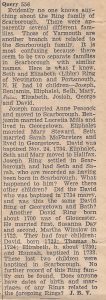
This scrapbook, accession number 2018-35-1, is a collection of newspaper clippings. The vast majority of the clippings are unlabeled and unidentified as to the newspaper or the date. However, some of the clippings have handwritten dates on them identifying them to be from as early as 1931 to as late as 1950. The majority of dates are 1933. The donor of this scrapbook was Margaret Small.

The clippings primarily include marriage announcements and obituaries with many entries regarding the accomplishments of various Scarborough people.

In its 53 pages there are 74 instances of “Scarboro” six of “Dunstan,” 14 of “Oak Hill,” 22 of “Black Point,” 30 of “Pine Point,” and two of Higgins beach.

The scrapbook was scanned at 400 DPI, cropped as appropriate, and rotated as needed, then it was OCRed using FineReader and exported as a searchable PDF file on Digital Maine.

Posted in Scrapbooks | Tagged , , , , | Comments Off on Margaret Small Scrapbook – A2018-35-1

Corporal Lucian Thomas Libby

Photo of Lucien T. Libby

Lucien T. Libby

I recently received a question regarding the life of Corporal Lucian Thomas Libby of Scarborough. Lucian died of wounds during World War I. His questions were, do we know which battle he died in and if there are relatives in the area?

My “go-to” place for his first question is Family Search. There, I was able to quickly find the Grave Card for Lucien T. Libby[i]. It indicated that he is buried in Black Point Cemetery, in section A, and that he died on 22 October 1918 in Souilly, France. Souilly was the headquarters for General Pershing during the Meuse-Argonne Offensive. Lucien served with the 13th Company, Coast Artillery, Maine National Guard (Battery F, 103d Field Artillery Unit). The Meuse-Argonne Offensive was, according to Wikipedia, the largest and bloodiest operation of World War I. The offensive, also known as the Hundred Days Offensive, brought the war to an end. 26,277 American lives were lost. Corporal Libby was wounded on 11 October 1918, exactly one month before the end of the war. The 24-year-old lived 11 days before succumbing to his injuries.

Lucien T. Libby

  • Born:           29 June 1894[ii]
  • Enlisted:       5 June 1917
  • Overseas:     9 October 1917
  • Wounded:   11 October 1918
  • Died:            22 October 1918

Photo by Kelli Lincoln

Further research revealed his name was Lucien Taylor Libby, not Lucien Thomas.”

Lucien was born in Scarborough the son of Charles E. and Sarah F. Libby. Both the 1900[iii] and 1910[iv] Censuses indicate that Lucien had two siblings, George and Lena.

Charles Libby set up a fund at the Scarborough Public Library to purchase books which exists to this day.

Lucien Taylor Libby is remembered through the American Legion’s Libby-Mitchell Post #76 in Scarborough, whose name honors him and World War II casualty Donald Mitchell.

I will remember Lucien, and his ultimate sacrifice, which helped bring an end to the Great War.

And yes, there are descendants of Charles Libby living today.


Endnotes:

[i] “Maine, State Archives, World War I (WWI) Grave Cards, 1914­1950,”
database, FamilySearch (https://familysearch.org/ark:/61903/1:1:QP4Y-VXW – accessed 30 October 2018), Lucien T Libby, ; citing Burial, Scarborough, Cumberland, Maine, United States,; Maine State Archives, Augusta.

[ii] “United States World War I Draft Registration Cards, 1917-1918,” database with images, FamilySearch (https://familysearch.org/ark:/61903/1:1:KZFR-9ZM – 13 March 2018), Lucian Taylor Libby, 1917-1918; citing Cumberland County no 2, Maine, United States, NARA microfilm publication M1509 (Washington D.C.: National Archives and Records Administration, n.d.); FHL microfilm 1,653,905.

[iii] “United States Census, 1900,” database with images, FamilySearch (https://familysearch.org/ark:/61903/1:1:MMLF-NR9 – accessed 28 November 2018), Charles E Libby, Scarborough town, Cumberland, Maine, United States; citing enumeration district (ED) 78, sheet 14B, family 346, NARA microfilm publication T623 (Washington, D.C.: National Archives and Records Administration, 1972.); FHL microfilm 1,240,591.

[iv] “United States Census, 1910,” database with images, FamilySearch (https://familysearch.org/ark:/61903/1:1:MR3M-Z4P – accessed 28 November 2018), Charles E Libby, Scarboro, Cumberland, Maine, United States; citing enumeration district (ED) ED 101, sheet 16A, family 376, NARA microfilm publication T624 (Washington D.C.: National Archives and Records Administration, 1982), roll 538; FHL microfilm 1,374,551.


Posted in They Answered the Call | Comments Off on Corporal Lucian Thomas Libby

Once Upon a Time (In Scarborough)

From the Bruce Thurlow Collection

Scrapbook clippings from newspapers regarding “Once Upon a Time” [in Scarborough]. The articles include newspaper images and short write-up regarding various Scarborough objects, businesses, and places. Download from the Maine State Library.


Posted in Black Point, Blue Point, Coal Kiln Corners, Dunstan, Higgins Beach, North Scarborough, Oak Hill, Pine Point, Prout's Neck, Scrapbooks | Tagged | Comments Off on Once Upon a Time (In Scarborough)

Scarborough High School – Class of 1949

Scarborough High School – Class of 1949

Image of the Scarborough High School Class of 1949

See Digital Maine for a 9036 × 6847 image.

Front Row – Peggy Deering – Lorna Hersey – Mary White – Eunice Lilly – Richard Marr – Delbert Pike – Angie Marshall – Gladys David – Betty Frost

2nd Row – Dot Bimpson – Barbara Noble – Jean York – Ruth Worthley – Priscilla Story – Alva Littlefield – Mary Davis – Joyce Kimball – Mrs Lary

3rd Row – Eleanor Tokarski – Eddie Fowler – Rudolph Douglass – Mike Wood – Bobbie Bowley – Jr. Bowens – Bobby Jannelle – Adelaide Higgins

4th Row – Tom Sturgeon – Stan Brown – Richard Buckley – Gordan Lord – John York – Dick Libby

Photo by: Jackson – White Studio, 536A Congress Street, Portland, Maine

From the Adelaide Scribner Collection

Posted in Schools, Students and Teachers | Comments Off on Scarborough High School – Class of 1949

The Reanimation of John Hasty – Scarborough 1798

[Ed note: I was recently at a Genealogy meeting and a friend, Nancy Wilson Latham, mentioned that she had come across an article on Genealogy Bank about a Scarborough resident who almost died from drowning in 1798, but was “reanimated” through a long process of 18th-century medical practices. I found the article and shared it with SHS President Rodney Laughton. Rodney found the article really interesting. Because it was printed in 18th-century fonts, it was really difficult to read so he transcribed the article into a more readable font. – Don Taylor]

Remarkable Instance of Drowning, and Reanimation in Scarborough, in the County of Cumberland, and District of Maine

This article was published in the Oriental Trumpet a Portland, Maine newspaper. (Vol. 1 Issue 56, page 4)  The date of publication was January 4th,1798.  It was previously published in a newspaper called the Centinel.  It is an account detailing the near drowning of a youth in Scarborough on July 17th, 1797. 

At the time of publication, an older style of English was popular.  Long and short versions of the letter ’s’ were commonly used.  The long ’s’ appears as a modern ‘f’.  For the ease of reading, I transcribed the article in modern usage.  (In the original text the name the victim’s appeared as John Hefty, in the transcription it appears as John Hasty.  At the time the incident occurred Maine was still part of the Commonwealth of Massachusetts.

Footnote research and transcription was done by Rodney Laughton, October 2018.

From the Centinel.
Mr. Russell, 
You will gratify your readers, and oblige the Trustees of the Humane Society(1), by inserting the following.

Remarkable instance of Drowning, and Reanimation, in Scarborough, in the county of Cumberland, and District of Maine.

On 17th July of the present year, several boys, neither of whom had learned to swim, retuning from school, between the hours of twelve & one, went into the river to bathe, at a place called Black Point Causeway(2). It being near the last of the ebb tide, the water was about two an half feet deep. John Hasty(3), a lad of about fifteen years of age, was the oldest and largest of the children. —— They waded down the bed of the river, to a place called Warren’s point. 

John Hasty took the lead; and when at a little distance from the other, he suddenly disappeared. His companions, at first, concluded that he was in sport, and that he meant to surprise them; But they were soon undeceived. Halting, they saw him rise nearly half his length out of the water, and then sink again. Soon after they saw the back part of his head above the water, which again disappeared; and when he rose a third time, they saw the tops of his fingers only. These several appearances convinced them, that he had ventured into water deeper than his own height, and that he was actually drowning.

The children were unable to afford him any seasonable assistance. Simon Libby, one of the number, who was perhaps twelve years of age, and who had not been in the water, ran therefore for assistance towards the house of Thomas Libby(4); and seeing some persons at a distance in the field, passed the house and carried the information to them. Jack Green, another of the children, and of the age of the last mentioned, left the water in which he had been wading, put on his shirt and trousers; ran to the house of the same Libby, which was half a mile distant, and called for help. Silas Libby(5) a youth of about nineteen years of age, was sitting in the house, and amusing himself with a violin.No sooner was he acquainted with the melancholy event, than he ran to the causeway, where he found one of the children only, John Beals(6), standing on the point. Informed by him where the lad disappeared, and making some allowance for the influence of the tide, Silas Libby plunged headlong into water seven or eight feet deep, and passed over the body, just touching it with his toes. The water being disturbed he could not at first discern the body; but turning round under water, he at length discovered the lad lying on his face, with his arms extended, and face immersed to the ears in mud. He then took the body in his arms, and conveyed it to the shore.

When Silas Libby’s father came within hearing, he inquired of him what was to be done, for the lad was dead. The father told him to toss the body up and down in the air, which he did till he came to his assistance. The downed lad’s countenance was as dark as a mulatto. They then placed the head downward, and stroked the belly, upon which water issued from the mouth, ears and nose and clotted blood from the nostrils. By this time, Mrs. Libby came to the place and putting off a petticoat, spread it on the marsh; and the body was laid on it.

At this moment Thomas Libby(7), the brother of Silas imagined that he perceived symptoms of life.———Major William Hasty(8), the drowned lad’s father was then sent for. He was at the distance of a mil an half. The body, in the mean time which was perfectly supple, was removed to the house of Thomas Libby. 

When the father of the lad arrived, he found the body placed on a barrel, which some of the persons assembled were rolling. Of this rolling he disapproved, having lately read the directions of the Humane Society, relative to the treatment proper in cases of Drowning. He therefore directed that a bed should be warmed; that the body should be wrapped in blankets; and that it should be rubbed with warm cloths wet with rum (the only spirit then at hand) and sprinkled with fine salt. The jaws were set. ——It was noticed that when the body was at rest the symptoms of reanimation disappeared; but that they returned when the body was tossed up and down in an erect posture.

Soon after the father’s arrival, Mr Rice, the nearest physician, was sent for. His house was five and a quarter miles distant(9); but his benevolent zeal brought him to the place sooner than was expected. Thirty minutes and an half only elapsed from the time Major Libby went in quest of him until the Doctor arrived. An uncommon instance of dispatch and success. A vein was opened and the lad bled freely. Tobacco-smoke was blown by means of a pipe through the anus into the bowels(10); upon which, for the first time, the lad drew a long breath. Two glisters were successively administered(11); It was however, several hours before they had a visible operation. Brandy being procured by direction of the physician, the body was washed with it, and a tea-spoon full of it mixed with water was administered internally every two or three minutes. The father then undressed himself, went to bed, and embraced the lad, whose body was wrapped round with flannel and baize(12), wet with brandy and covered with salt. At frequent intervals the lad was taken out of bed, and tossed up and down in the air; which was found to be very favorable. In six hours he spoke, but incoherently. In nine hours his reason appeared at intervals. In two or three days he walked about; but it was fourteen days before the lad’s health and agility were perfectly restored. In the month of November, he had no recollection of ay thing which took place on the seventeenth of July, the day on which the accident happened.

At the request of the Rev. Doctor Parker, this account was obtained and communicated by the Hon. Judge Sewell of York.In his letter he expresses the utmost confidence in the veracity of the persons who furnished him with the facts. According to his calculation, the lad was certainly fifteen minute, probably between twenty and thirty minutes under water.—

The persons, who so singularly exerted themselves, and with so much success, he recommends to the particular attention of the Humane Society.A conviction of their merits induced the Trustees, at the last meeting (4 Dec.) to vote Ten Dollars to Silas Libby, a Medal(13) to Major Libby, Two Dollars to Simon Libby, and the same sum to John Green and John Beals, for their respective exertions. 

At the same meeting, the following report was made and accepted.

The trustees of the Humane Society, having in their private capacity been informed of several instances of persons who had incurred apparent death by drowning or otherwise, and been fortunately recovered by the means recommended by the Society, and no communication made therefor and convinced the publishing the circumstances of such incidents would be attended with beneficial effects, hereby request that citizens of the Commonwealth, and particularly the gentlemen in the Medical line, to communicate to the Corresponding Secretary all the instances that have or shall come to their knowledge, of reanimation, and the means whereby those happy events are accomplished, with such other particulars of the time respiration was suspended, &c. as they shall think of importance to notice: As it is by comparing the success of different means and operations that this important art can be brought to perfection. The Trustees are also desirous of extending the rewards promised by the Society for signal exertions throughout the Commonwealth, and for this reason they request information even if they prove unsuccessful.

N. B.The Trustees requested the same favor from the citizens of the neighboring States.

An Extract from the Minutes of said Trustee,
JOHN AVERY,
Recording Secr’y.


Footnotes

1.  The Humane Society of the Commonwealth of Massachusetts was formally established in 1786.  The members were concerned about the needless deaths resulting from shipwrecks and drowning and wanted to find ways to save lives.  It was the model for the organization that would eventually evolve into the U.S. Coast Guard.

2.  The Black Point Causeway is the common name for the stretch of Black Point Road that crosses the marsh between the present day site of the Hunnewell House and the high ground where Highland Avenue begins.

3.  John Hasty, born 1782, died after 1845.  He married and had a number of children. (Family Search – Login required but no fee.)

4.  Thomas Libby Sr. 1743-1824, He was a farmer who was born and died in Scarborough.  He was the father of 10 children.

5.  Silas Libby 1777-1801  He died at sea and was unmarried.  His nephew Silas who was named for him would be the builder of the Cammock House.

6.  John Beals 1788-1854, born in Scarborough, he married Abigail Libby, of Scarborough and they had three children.  After her death, he left Scarborough, remarried and had 9 more children.

7.  Thomas Libby Jr. 1784-1872, born and died in Scarborough. He was the father of 12 children.  He owned Prouts Neck in its entirety and called it Libby’s Neck at that time.

8.  Major William Hasty 1753-1831, born and died in Scarborough.  He was married to Anna Libby Clark.  They had two children, John, the subject of this article, and Daniel.

9.  Dr. Rice – His house was later occupied by Dr. Alvan Bacon and also Dr. George Roy in Dunstan.  The house is still standing, moved back from Route One.

10.  Tobacco enemas were a treatment used in the late 18th century for a number of ailments including the revival of persons near death from drowning.

11.  “Glister” is an archaic term for “enema”.

12.  Baize – a coarse woolen or cotton fabric napped to imitate felt.

13.  The Medal Awards Program was instituted by the Humane Society to recognize rescue efforts and the accompanying financial stipend acknowledges the individuals who acted heroically to save lives.

Posted in Black Point, Blue Point, History, People | Comments Off on The Reanimation of John Hasty – Scarborough 1798