M.F. Tilton letter to C. L. Libby Esq. 18 Jun 1889 – 70.14.17.I

Click to Access PDF Varsion.


Unformatted Transcription Text Below

June 18th 1889
92 Cedar St. Bangor
Dear Sir;
Yours of the 11th inst was duly rec’d – I was pleased
to know more definately your plan for that “contemplated History”
you surely are entering upon a task of great magnitude with
a dubious prospect of any help fromnthose now on the stage – for
myself, were we to meet, your questions might draw out some
useful material, wh’ the cold sted fails to recal, to my regret ,
My Father’s account Books and business records went to Minn,
with my brother Henry – who passed away 7 or 8 yrs since as
to records of income from his pupils, I can state that his
charges from all ages never exceeded $1.75 for tuition ,
board and washing per week, for those who stayed over Sunday!
Yet some were sure it was a great charge! but were anxious to
get their unruly troublesome boys under his mild but effectual
discipline.
Pg 2
He never resorted to corporal punishment I never sent a boy
away tho obligid to refuse many from /Lek of room ” oh put
them in the barn, only take them, “was the cry of several
parents! We had boys of 7, 8 yrs of age to 18, 20, Greek,
Latin, Mathematics, Reader mingled in one room and all were
amenable to my humble self when Father was called to Parish
duties – when out of school – These are trifles – but show
chatacter of both parties – some 25 boys were with us at
different times – left pleasant memories – Domestic afflic-
tion Cpmpeled Father to give up school in 1828, he was chosen
Preceptor of a New Academy at Buxton – You may find several
of his pupils among the middle and also aged residents of
upper Scar, also Buxton who were warm friends to his last
days. The ignorant parsimonious class of Scar. 2d Parish
caused his giving up the desk. Some disliked “College
Larned” preacher some “preaching for pay” and as each one
“signed off”as the law allowed, their tax Father gave up- till-
yearly salary was reduced to $150. and that hard to collect.
While we had boys he preached without pay that Sunday might
be a Sabbath day to them and not to them alone for others
attended and he was expected to visit the sick and attend
funerals as when a regular pastor. The Methodist and Baptist
sects caused much disruption of religious ties. They
protest to labor gratis which suited many. Mr. Heath the
earlist Meth, preacher at Dunstan wasn’t genial, fanaticism
displaced reason and sohe felt it a duty to embrace an oppar.
to harass Father – At meetings in distant parts of a 6 miles
parish wxtent. One famale widow arose and harangud the
gathering before he closed. The same colledted others and
came some miles to pray and sing before our house – he took
no notice of any of thesL scenes – to deeply wounded. In
later days he went often to the Methodist meeting when his old
parish were minus preaching and a change came in the Methodist
characteristics – he communed with them and enjoyed social
intercourse with pastors and people. I mention these facts
AS show the element from which came the “Cochrane” sect, it
cannot be called religious as sensuality seemed to prevail
to such a degree at length that Saco authorities razed the
building where its devotees held their orgies and broke up
meetings of Scarb. and other towns uniting with them. Mr. S.
in his book names Cochrane a minister – rather a scapegrace,
strongly magnetic – bringing weak ones into his toils. State
Prison clained him at last.
Previous to the inroads of this class of fanatics regular S.
meetiings were well attended – young people were walking 4
and 6 miles or riding part way in turn “ride and tie” was the
term used – some on howseback with wife on pillion behind
them a large block near the yard stood ready to alight and
mount from. One good old man I remember was so deep in thots
of what he heard that he failed to miss the clasp of his
wife round his waist, and rode off leaving her perched on the
block till someone called him back.
The meeting house with its 2 score of large windows, was
guiltless of stove or furnace heat – women had foot stoves
which they renewed with coals at the parson’s house opposite
where good fires in winter were ready and benches purposely
encircling the big fireplace for general use. In summer the
water pail and drinking cups were provided and both arrangements
were wetf patronised at intermission – Those coming a distance
bringing their lunch found the fire and water very acceptable.
The parson’s family had a busy day – someone must keep guard
and replenish all needful.
How unlike present usages were many customs of past days.
Civilization has taken from us much that simple, informal
and enjoyable in return we haveebeauty, grandeur, leisure,
and great progress in science and all that tends to mental
and spiritual development. Can we say it has left integrity,
uprightness and purity of character. Scarboro had many very
sterling characters – but with these mingled another element
of the savage nature – imbibed another element or early contact
with and dread of their Indian foes – Proofs of this were
evident in the treatment of Mr. King and others for differences
of views during the Revolution. Father occupied the King house,
near the Landing so called, the first decade of his ministry –
as a child I well remember seeing marks of the axe gashing the
beam in the hallway made by the mob, that in other savage
ways insulted and even sought his life by placing ropes across
the road to throw him from his horse at night etc. These savages
were not all Scar, men but some were known to be. One specially
rose to be Deacon of the church in later days but Mr. King’s
daughters Mrs Southgate refused to take the elements from his
hand and he was changed to the opposite aisle. He was a saint-
ly man I remember in looks.
When reading your purposed plan, my sister agreed with me in
saying there were some pages we cared not to turn, in such a
view of our dwelling place – even our near neighborhood had
many undeveloped beings – whose deeds were outside the pole
of civilized life. They have put off the flesh with its temp-
tations and I will not revive their life course – rather turn
to more attractive subjects.
When Father settled there, Dunstan was quite a busy place,
lu±ber trade and building vessels at the Landing employed
many – several stores were well supported – the owners of them
moving to Portland when that business ended – this changed the
place greatly – men of energy like Jewet Wm. Wood – Capt.
Haines – Rufas Emerson all well known citizens of P. whose
children live there now and began their life in Scar. Society
was good large families graced these homes but as business
died out and no new enterprize succeeded young men left for
other prospects. The town was called a good place to migrate
from and it has sent out to enrich and grace various points
of our broad land many who have won both fame and fortune as
well as benifiting the world by talents improved.
One of the odd characters of the time, was Richard or Dick King
as generally called a brother of Rufus, on his Father’s side
and Gov. Wm. and Cyrus of Saco – but unlike any of them – a man
of great physical and mental power but without culture – pique-
ing himself on lack of it – yet he was well read specially in
T. Paine’s works professing to Deistic views – he was strong in
argument and often silenced opponents by witty retorts – during
the war of 1812 he was a released prisoner from Halifax, I think
was carried into N.Y. in a delipated state of apparel – buying
a yd of cotton cloth he tied up his neck – went to brother Rufus
house and sent in his name. Rufus had a party of distinguished
men at dinner. He told the servant to show the gent in at once –
he came very gingerly avoiding to step on the flowers of the
rich carpet – Pretending to think them real and wishing to
mortify his aristocratic brother – but failed – his party were
surprised when introduced but confounded when listening to his
philosophical conversation. He lived on Scottow’s Hill – had a
large family not one like to himself in any respect – a son
became Methodist preacher. Dick King the Infidel was a noted
chatacter then – now, we dont fear the influence of Paine’s
followers but understand better the true animus of the man –
one step up in civilization and liberalityof thought.
The best part of 2 Parish in S. was on the Nonsuch river and
Beach Ridge where were many thrifty farmers whose sons went to
Mass., and farther west, doing credit to the old town. Portland
also has the honor of several solid men from that younger stock
but I know nothing of the present inhabitants – thirty five
years have passed since leaving there – changes for better have
no doubt taken place – the sterile soil of Dunstan and Broadturn,
may now bear fruit from mechanics and artizan culture while some
seed sown in the past on mental soil may have slowly taken root
under more favorable circumstances of the present day. I have
jotted down at various times this potpouri of words as they rose
to mind, if you care to read and canegather any grains of wheat
from sc much chaff – put it to use – if not give the scrap
basket these pages. Questions might have called up some things
more to your purpose and spared you much you may find irrele-
vant.
However I mail it with the best wishes of
Your Aged Friend
M.F. Tilton
To C.L. Libby Esq.
6-18-1889


From: 70.14.17 I – Transcription – M.F. Tilton letter to C. L. Libby, Esq. 18 June 1889 – 70.14.17.I.pdf

Posted in Surname Files | Tagged | Comments Off on M.F. Tilton letter to C. L. Libby Esq. 18 Jun 1889 – 70.14.17.I

January 2022 – Website Updates

Education

High Schools 

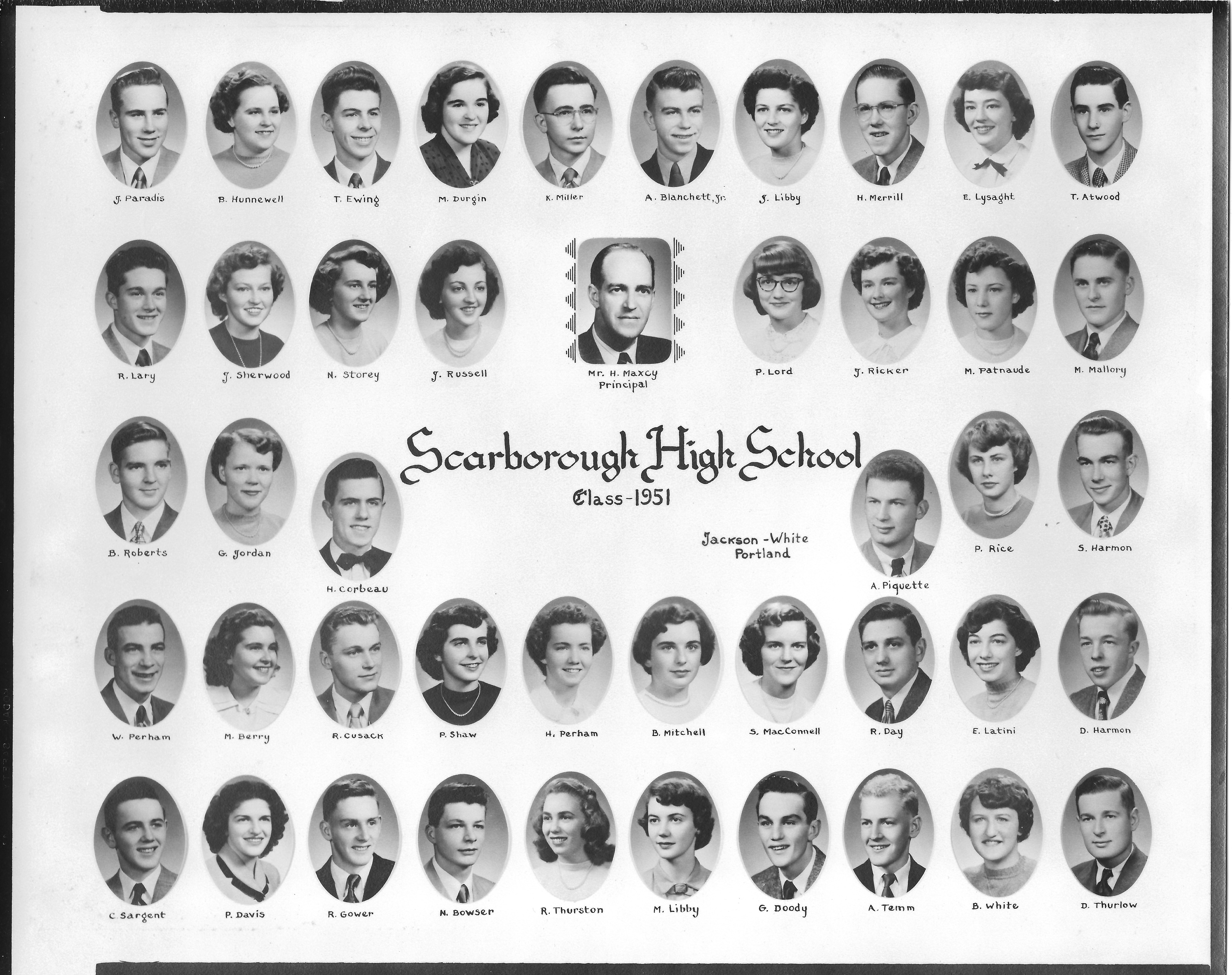
The following yearbooks were uploaded to Digital Maine:

  • Four Corners (Scarborough High School Yearbook) – 1949 to Digital Maine.
  • Four Corners (Scarborough High School Yearbook) – 1959 to Digital Maine.
  • Four Corners (Scarborough High School Yearbook) – 1960 to Digital Maine.
  • Four Corners (Scarborough High School Yearbook) – 1963 to Digital Maine.
  • Four Corners (Scarborough High School Yearbook) – 1964 to Digital Maine.
  • Four Corners (Scarborough High School Yearbook) – 1968 to Digital Maine.
  • Four Corners (Scarborough High School Yearbook) – 1969 to Digital Maine.
  • Four Corners (Scarborough High School Yearbook) – 1970 to Digital Maine.
  • Four Corners (Scarborough High School Yearbook) – 1971 to Digital Maine.
  • Four Corners (Scarborough High School Yearbook) – 1972 to Digital Maine.

Owascoag Notes

There was a problem on page 4 of the January/February 2022 Owascoag Notes newsletter; it was missing the image of the Southgate House. An updated version of the newsletter including the Southgate House image is HERE

Posted in Education | Tagged , | Comments Off on January 2022 – Website Updates

December 2021 – Website Updates

Education

Grammar School Page

I added a 1939 example of a Grammar School Certificate (Mary E Wright – 16 June 1939).

High Schools 

Organizations

The Civic League

I added:  The Civic League was the forerunner of the PTA in Scarborough.

Links

Civil War

Maine at War: Scarborough’s Hiram Berry fought in Louisiana and Virginia

Surnames

Small Surname File I added:

Posted in Education, Organizations, Surname Files | Comments Off on December 2021 – Website Updates

Holiday Cheer at the Museum

Thank you to the Scarborough Garden Club, for the beautiful holiday wreaths to decorate the museum’s doors this year. Also, thank you to Joyce Alden for the boughs, berries, and ribbons used to decorate the window boxes.

Garden Club members Elaine Mallory, Marie Leyro, and Karen Thompson.
Photo by Karlene Osborne.

Photos by Joyce Alden

Posted in Displays, Garden Club | Comments Off on Holiday Cheer at the Museum

SAVING SCARBOROUGH’S LAST DISTRICT SCHOOL

By Linda Snow McLoon

Scarborough Historical Society members visiting the old Beech Ridge school.
Photo Courtesy Karlene Osborne.

Before there were big yellow school busses, school children in Scarborough for the most part walked to school. To keep the distances from their homes doable, back in the 1800s Scarborough had over a dozen one-room district schools spread throughout the town. A single teacher taught the elementary grades to each neighborhood’s school children.

All the district schools were torn down or repurposed over time – with one exception. Although vacant for decades and falling into disrepair, District No. 7’s Beech Ridge School, located at 184 Holmes Road, managed to survive over the years. In 2018 the Scarborough Historical Society stepped forward to save this important part of the town’s history. The society was deeded ownership so it could proceed to raise funds and oversee the restoration of the building.

Thanks to donations and grants for the project, much work has been accomplished. Phase I started with lifting the building so a new foundation could be poured. Later the rotted sills were replaced while adding a brick veneer to provide the appearance of the original foundation. After the interior was gutted, a basement stairwell and bulkhead were added. Phase II of the restoration work will include, among other things, putting in insulation, electricity, and plumbing. The roof will be shingled and new windows and doors installed. Lastly, historically accurate vertically-sawn exterior clapboards will be applied to the exterior of the building.

The Beech Ridge School’s scholars posed in 1915 with their teacher, Mabel Storey.
It appears that shoes were in short supply for children at that time.
Photo Courtesy Scarborough Historical Society Collections

Once the restoration work is completed, the building will be available to the community for multi-functional uses. As an educational component, period school artifacts and displays will help visitors learn what school was like in a one-room school in an earlier time.


John Hearn was a teacher at the Beech Ridge school in the 19th century.
Photo Courtesy Rodney Laughton Collection

Martha Pillsbury was the Beech Ridge school’s teacher in 1866.
Image from the Scarborough Historical Society Collections.

Scarboro; Aug/ 31st 1866…

Town of Scarboro:
     To M. A. Pilsbury for teaching in District No. 7 twelve weeks at four dollars 16/100  per week; Fifty-Dollars

Received Paym’t Martha A Pillsbury

The Scarborough Historical Society is appreciative of the funding it has received for the project from the Town of Scarborough and the Prouts Neck Historical Society, in addition to donations made by many other supporters.

We are well on our way to saving this precious remnant of our past, but there is still a lot of work to be done. We hope for additional donations toward the $150,000 currently needed to finish the job. Checks may be sent to the Scarborough Historical Society, P.O. Box 156, Scarborough, ME 04074, or donations made to www.gofundme.com/SHS-Restore-Beech-Ridge-School. The Scarborough Historical Society is a 501(c)(3) nonprofit organization, making all much-needed donations fully tax-deductible.

Interior Beech Ridge School
Photo by Karlene Osborne – c. Apr 2021

Beech Ridge School ready to be lowered onto new foundation (Apr 2020)

This article was first published in the Scarborough Leader and is republished here with the permission of the author.

Posted in Beech Ridge School, Education, Newspaper Clippings, North Scarborough, Projects, Students and Teachers | Tagged , , | Comments Off on SAVING SCARBOROUGH’S LAST DISTRICT SCHOOL