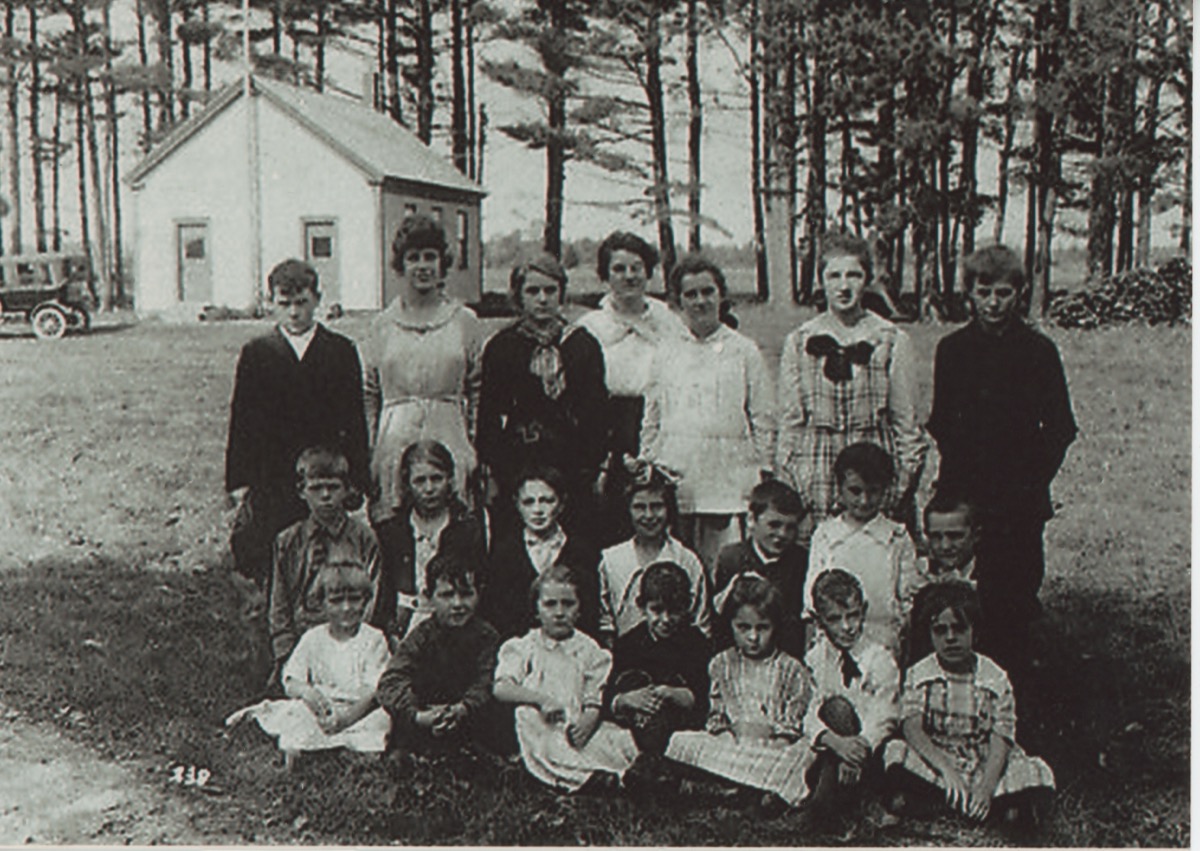
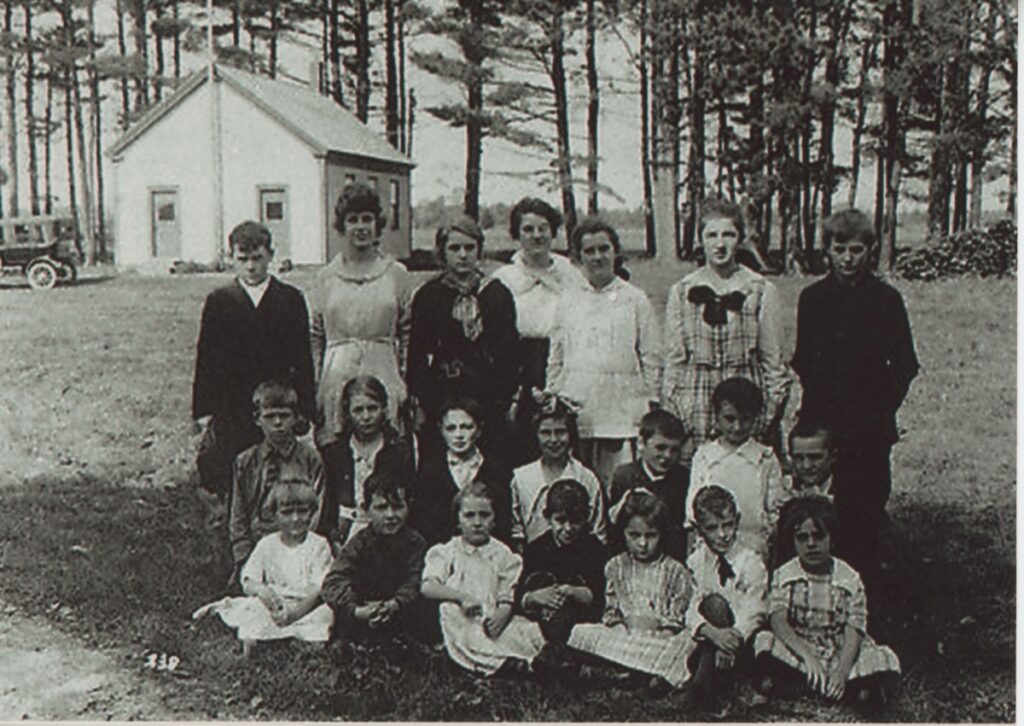
Students and teacher at Coal Kiln Corners School, Scarborough, Maine, circa 1920. Note the early touring automobile at left.
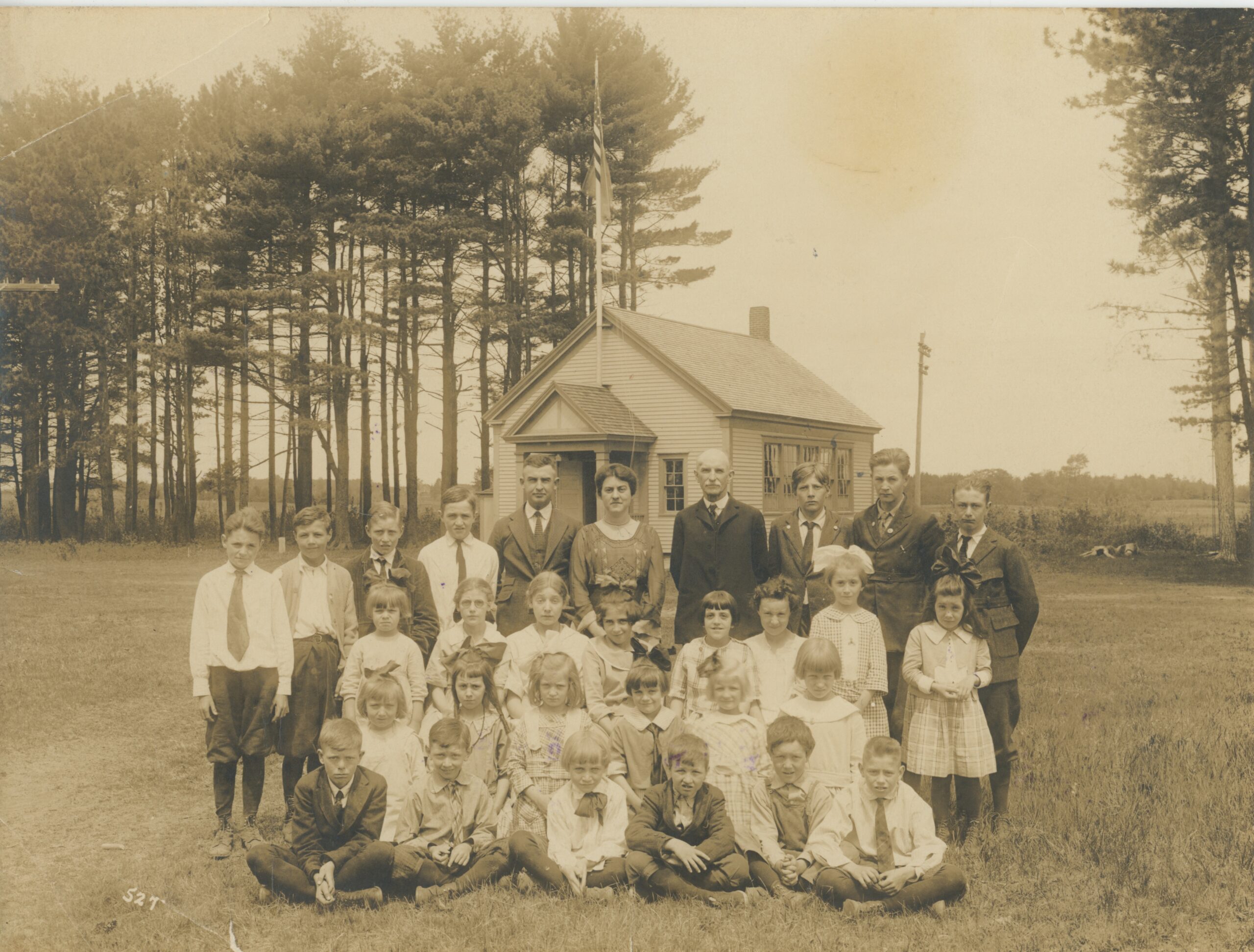
I recently reviewed a photo of the North Scarborough School (Coal Kiln Corners School) from about 1920. It was quite a plain building; it had two entrances, one for boys and one for girls. Today, I am reviewing a photo of the same school from 1922. It is quite different. It has a single entrance with a portico. The windows along the side of the building changed from three separate to five adjoining windows. Also, Superintendent F. H. B. Heald is in the photo. I had never seen Superintendent Heald in an outside class photo before, so I wondered what was going on with the school that it would have so many changes, and Mr. Heald would be there.
Town reports are often a goldmine of information. Sure enough, in the 1920 Town Report, Superintendent Heald reported that the State Department of Education established a new program for the “Standardization and Beautification of Elementary Buildings.” None of the Scarborough schools met the new standards. Being the smallest of the schools, North Scarborough would be the first brought up to the new standards “in the matters of heating, lighting, ventilation, and toilet facilities. The 1922 report stated that standardization work at the North Scarborough school was completed, and the expenditures totaled $640.58 (about $12,585 in today’s dollars).
North Scarborough School students and Superintendent F. H. B. Heald, 1922. The recently renovated schoolhouse, now featuring a single entrance with portico and new bank of windows.
I’m sure that Superintendent Heald was at this photo event because North Scarborough was the first school to undergo the standardization.
In October 1995, Lena (Dow) Bachelder provided the identifications for most of the individuals.
I was recently asked, “When did Scarborough made the transition from local solar time to mean time?“
When the Eastern Railroad reached Scarborough in 1842, it did more than connect the town to Portland and Boston—it quietly introduced a new way of thinking about time.
Before the Railroad: Scarborough Kept Its Own Time
Prior to rail service, Scarborough—like most Maine communities—operated on local solar time. Noon was when the sun stood highest over the town. Because Scarborough lies slightly east of Portland and west of towns further down the coast, its “true noon” differed by a few minutes from its neighbors.
For farmers, merchants, and schoolchildren, this variation posed little difficulty. Life followed daylight, not the clock.
The Railroad Arrives: A Different Kind of Precision
Railroads required something Scarborough had never needed before – exact, uniform timekeeping.
The Eastern Railroad operated on a standardized schedule tied to a central reference time — Typically Boston time in its early years. This created an immediate disconnect:
Train crews—conductors, engineers, and station agents—carried railroad-regulated watches, often checked against a master clock at major terminals.
Stations displayed time that matched the railroad schedule, not necessarily the sun overhead.
Local residents, however, still lived by solar time—at least initially.
How Railroad Crews Kept Time
Railroad personnel followed strict protocols to maintain accuracy:
Conductors used precision pocket watches, regularly inspected and synchronized.
Telegraph systems allowed dispatchers to communicate time signals along the line.
Schedules were written in a single, consistent time standard, eliminating ambiguity for train movements.
This system ensured that trains passing through Scarborough did so safely and predictably, even if the town’s clock disagreed by several minutes.
A Town Between Two Times
For decades after 1842, Scarborough effectively lived with two parallel time systems:
Activity
Time Standard Used
Farming, household routines
Local solar time
Church services, schools (initially)
Local solar time
Train departures and arrivals
Railroad (standardized) time
Commerce tied to rail shipments
Increasingly railroad time
This dual system could be confusing. A resident might be told a train departed at “10:15,” but unless they knew whether that meant local or railroad time, they could easily miss it.
Gradually, however, the influence of the railroad began to dominate. Businesses, post offices, and eventually schools aligned their clocks with train schedules for practicality.
The Turning Point: Standard Time in 1883
The confusion persisted across the country until November 18, 1883, when railroads collectively adopted standardized time zones. Scarborough fell into the Eastern Time Zone, aligning its clocks with a regional standard rather than purely local solar time.
Newspapers helped explain the transition, as towns reset their clocks. Sometimes towns experienced “two noons” in a single day.
What It Meant for Scarborough Residents
By the late 19th century, the change had fully reshaped daily life:
Train travel became reliable, with clear, consistent schedules.
Local institutions synchronized, reducing confusion.
Personal timekeeping shifted, as residents adopted standardized clocks and watches.
What began in 1842 as a practical necessity for railroad crews gradually transformed how every resident of Scarborough experienced time.
Why It Matters
The arrival of the Eastern Railroad did not immediately change how Scarborough told time—but it introduced the need for change. Over the following decades, the discipline of railroad scheduling replaced the flexibility of solar time, linking the town to a broader regional and national system.
In this way, the railroad did more than move people and goods—it synchronized Scarborough with the modern world. Today, as you walk along the Eastern Trail, the path the Portland, Saco and Portsmouth Railroad followed in 1842, (and was bought by the Eastern Railroad in 1872) think about how our relationship with time has changed, all because of the railroads.
Note: an abbreviated form of this article was first published in the May/June 2026 issue of Owascoag Notes.
Disclaimer: This article was researched and written by the author. ChatGPT was used as a research and drafting aid, and Grammarly for editorial review and copyediting.
Scarborough, Maine – Circa 1920 SHS Photo Collection #2014.17.02 By Don Taylor
The Scarborough Historical Society holds many photographs of Scarborough’s early schools. These images preserve not only the buildings but also the students and teachers who formed the heart of those rural communities. This photograph, taken of the “Coal Kiln Corners School,”[i] provides a valuable glimpse into education in early 20th-century Scarborough.
The Photograph
This image shows a group of approximately twenty students posed with their teacher in front of the Coal Kiln Corners Schoolhouse. The building is a modest one-room structure set among tall pine trees.
To the left of the school stands an early automobile, likely an open touring car.
Description
Image Type: Group photograph (students and teacher), outdoor setting
Location: Coal Kiln Corners School[i], Scarborough, Maine
Composition:
Teacher and older students standing in the rear
Younger students seated and kneeling in front
Notable Feature: Early automobile parked to the left of the schoolhouse
Dating the Photograph
Careful analysis of both clothing and the automobile provides a reliable date estimate.
Automobile Evidence
The vehicle appears to be an open touring car, consistent with cars between 1915 and the early 1920s.
Clothing Evidence – Teacher and Older Girls
High-necked blouses and modest dresses
Natural waistlines (not dropped)
Hair worn up or pinned back
Younger Children
Knee-length dresses, pinafores, and long stockings
Boys wearing knickers and collared shirts
Interpretation
Absence of bobbed hairstyles (common after ~1923)
Prevalence of traditional, high-waisted garments
Touring automobile typical of the late 1910s to early 1920s
Conclusion
The photograph most likely dates to circa 1918–1922, with a strong probability around 1920.
Identification Effort
At present, the individuals in this photograph have not been identified.
Do you recognize any of these students or the teacher? Do you have family members who attended Coal Kiln Corners School? Do you have other photos of Coal Kiln Corners School or its students you would like to share?
Please share your knowledge to help us preserve Scarborough’s history.
[1] The donor of this photo called it the “Coal Kiln Corners School,” and I used this name in this article. This photo appears to be the same school building as is known as the North Scarboro School. This appears to be an earlier version of the school before it was either rebuilt at the same location or had a major renovation that included a change from two front doors to a single front door with a portico. Also, a change to the windows on the side of the building and electrification in the area.
Disclaimer: This article was researched and written by the author. ChatGPT was used as a research and drafting aid; Grammarly was used for editorial review and copyediting.
SHS Graduation Photos #2026.03.11, .12, .13, .16, & .17 By Don Taylor
The Scarborough Historical Society holds many photos of Scarborough Students. To preserve these important photos, they have been digitized and are shared here. But, this digitization project isn’t just about preserving history; it’s about reconnecting families with the visual legacy of their ancestors, many for the first time. Join me as I share these remarkable images and the stories behind them, bridging more than a century of memory and heritage.
These five students—graduates of Scarborough High School’s Class of 1931—represent a cross-section of families living across Scarborough, from Beech Ridge to Pine Point and Prouts Neck to Pleasant Hill. Their portraits, taken by a Portland studio, reflect both the aspirations and the formality of the era.
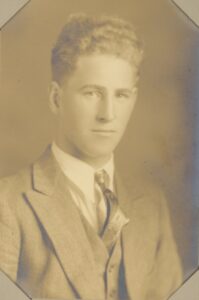
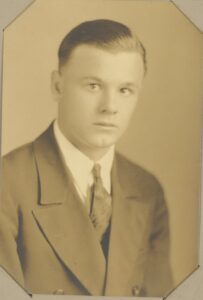
Ralph Berry (1912-1986), SHS Class of 1931
Ralph Donald Berry (1912–1986), Scarborough High School Class of 1931. Photo by Kennedy Studio, Portland, Maine.
Description
Image Type: Formal studio portrait – 4½” x 3”.
Photographers’ Imprint: Kennedy Studio – Portland, Me.
Identifying Information
Marks/Writing/Notes: Berry SHS ‘31
Other: Sticky note: “Ralph Berry, brother to Bill, died in 1980s
Research:
The Four Corners – 1931 (Scarborough High School yearbook) shows Ralph Donald Berry – “Berry” on page 13.
The 1930 US Census enumerated Ralph D Berry living with his sister, Sophia, and brother-in-law, Martin Ahlquist on Beech Ridge Road.
Ancestry Family Trees suggest that Ralph Donald Berry was the son of Hiram and Edith (Storey) Berry and had a brother Wilfred. Their father was Hiram Berry who died in 1915.
In 1930, Will was living with his sister Florence and his brother-in-law Chester Pierce in Portland.
Find-a-Grave has memorial 212857187 for Ralph Donald Berry (1912-1986)
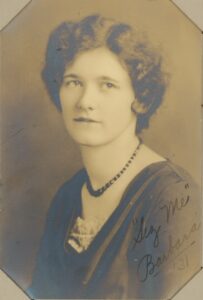
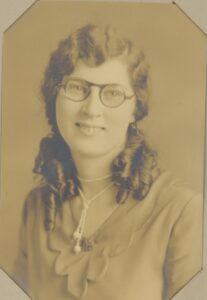
Barbara Mildred Grant, SHS Class of 1931
Barbara Matilda Grant, Scarborough High School Class of 1931. Photo by Kennedy Studio, Portland, Maine.
Description
Image Type: Formal studio portrait – 4½” x 3”.
Photographers’ Imprint: Kennedy Studio – Portland, Me.
Identifying Information
Marks/Writing/Notes: “Sez me” – Barbara ‘31
Other: Sticky note: “Barbara Grant lived on Black Point Road near Oak Hill.”
Research:
The Four Corners – 1931 (Scarborough High School yearbook) shows Barbara Mildred Grant on page 11.
The 1930 US Census reported Barbara M Grant living with her parents, William & Lena Grant on Prouts Neck Road.
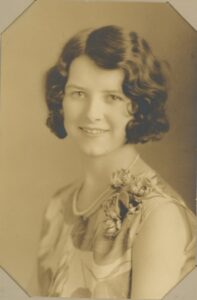
Frances Lothrop, SHS Class of 1931
Frances Emmaline Lothrop (“Fran”), Scarborough High School Class of 1931. Photo by Kennedy Studio, Portland, Maine.
Description
Image Type: Formal studio portrait – 4½” x 3”.
Photographers’ Imprint: Kennedy Studio – Portland, Me.
Identifying Information
Marks/Writing/Notes: Frances S.H.S. ‘31
Other: Sticky note: “Frances Lothrop married Sam Coney”
Research:
The Four Corners – 1931 (Scarborough High School yearbook) shows Frances Emmaline Lothrop – “Fran” on page 10.
The 1930 US Census enumerated Frances E Lothrop living with her parents, Howard & Inis Lothrop on Pine Point Road.
The Maine Marriage Index indicates that Frances E Lothrop married Samuel J Coney on 31 August 1932.
Marjorie Matilda Milliken, SHS Class of 1931
Marjorie Matilda Milliken, later Bragdon, Scarborough High School Class of 1931. Photo by Kennedy Studio, Portland, Maine.
Description
Image Type: Formal studio portrait – 4½” x 3”.
Photographers’ Imprint: Kennedy Studio – Portland, Me.
Identifying Information
Marks/Writing/Notes: Your Cousin, Marjorie SHS ‘31
Other: Sticky note: “Marjorie Milliken Bragdon, sister to Edgar , Mitchell Hill Road.
Research:
The Four Corners – 1931 (Scarborough High School yearbook) shows Marjorie Matilda Milliken on page 14.
The Portland Press Herald, Dec 26, 1948, page 34 reported Marjorie married William Joseph Bragdon on Christmas.
Harlan Edgar Plummer (1912-1938), SHS Class of 1931
Harlan Edgar Plummer (1912–1938), Scarborough High School Class of 1931. Photo by Kennedy Studio, Portland, Maine.
Description
Image Type: Formal studio portrait – 4½” x 3”.
Photographers’ Imprint: Kennedy Studio – Portland, Me.
Identifying Information
Marks/Writing/Notes: Sincerely “Tim” ‘31
Other: Sticky note: “Harlan Plummer – First member of the Class of 31 to die in 36 or 37. Died of cancer of the spine. Lived near Scarborough Beach Station on Highland Ave.”
Research:
The Four Corners – 1931 (Scarborough High School yearbook) shows Harlan Edgar Plummer – “Tim” on page 10.
The 1930 US Census enumerated Harlan E Plummer living with his parents, Henry & Alice Plummer on Rigby Road.
Find-a-Grave has memorial 108080256 for Harlan Edgar Plummer, who died 10 May 1938.
Conclusion
Together, these portraits document a generation coming of age during the early years of the Great Depression. Their later lives—marriages, occupations, and early deaths in some cases—reflect the varied paths taken by Scarborough’s young adults in the mid-20th century.
I would love to hear your reaction if any of these photos are of your family member. Especially if this photo is of a loved one for whom you hadn’t seen this photograph before.
Feel free to use these photos in your genealogical activities. The Scarborough Historical Society holds the originals in this Collection.[i]Please cite “Photo Courtesy: Scarborough Historical Society.”
Disclaimer: This article was researched and written by the author. ChatGPT was used as a research and drafting aid, and Grammarly was used for editorial review and copy editing.