By Don Taylor
I was recently asked, “When did Scarborough made the transition from local solar time to mean time?“
When the Eastern Railroad reached Scarborough in 1842, it did more than connect the town to Portland and Boston—it quietly introduced a new way of thinking about time.
Before the Railroad: Scarborough Kept Its Own Time
Prior to rail service, Scarborough—like most Maine communities—operated on local solar time. Noon was when the sun stood highest over the town. Because Scarborough lies slightly east of Portland and west of towns further down the coast, its “true noon” differed by a few minutes from its neighbors.
For farmers, merchants, and schoolchildren, this variation posed little difficulty. Life followed daylight, not the clock.
The Railroad Arrives: A Different Kind of Precision
Railroads required something Scarborough had never needed before – exact, uniform timekeeping.
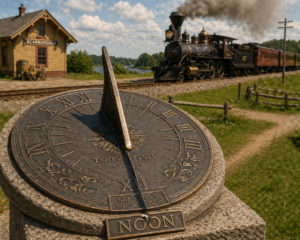
The Eastern Railroad operated on a standardized schedule tied to a central reference time — Typically Boston time in its early years. This created an immediate disconnect:
- Train crews—conductors, engineers, and station agents—carried railroad-regulated watches, often checked against a master clock at major terminals.
- Stations displayed time that matched the railroad schedule, not necessarily the sun overhead.
- Local residents, however, still lived by solar time—at least initially.
How Railroad Crews Kept Time
Railroad personnel followed strict protocols to maintain accuracy:
- Conductors used precision pocket watches, regularly inspected and synchronized.
- Telegraph systems allowed dispatchers to communicate time signals along the line.
- Schedules were written in a single, consistent time standard, eliminating ambiguity for train movements.
This system ensured that trains passing through Scarborough did so safely and predictably, even if the town’s clock disagreed by several minutes.
A Town Between Two Times
For decades after 1842, Scarborough effectively lived with two parallel time systems:
| Activity | Time Standard Used |
| Farming, household routines | Local solar time |
| Church services, schools (initially) | Local solar time |
| Train departures and arrivals | Railroad (standardized) time |
| Commerce tied to rail shipments | Increasingly railroad time |
This dual system could be confusing. A resident might be told a train departed at “10:15,” but unless they knew whether that meant local or railroad time, they could easily miss it.
Gradually, however, the influence of the railroad began to dominate. Businesses, post offices, and eventually schools aligned their clocks with train schedules for practicality.
The Turning Point: Standard Time in 1883
The confusion persisted across the country until November 18, 1883, when railroads collectively adopted standardized time zones. Scarborough fell into the Eastern Time Zone, aligning its clocks with a regional standard rather than purely local solar time.
Newspapers helped explain the transition, as towns reset their clocks. Sometimes towns experienced “two noons” in a single day.
What It Meant for Scarborough Residents
By the late 19th century, the change had fully reshaped daily life:
- Train travel became reliable, with clear, consistent schedules.
- Local institutions synchronized, reducing confusion.
- Personal timekeeping shifted, as residents adopted standardized clocks and watches.
What began in 1842 as a practical necessity for railroad crews gradually transformed how every resident of Scarborough experienced time.
Why It Matters
The arrival of the Eastern Railroad did not immediately change how Scarborough told time—but it introduced the need for change. Over the following decades, the discipline of railroad scheduling replaced the flexibility of solar time, linking the town to a broader regional and national system.
In this way, the railroad did more than move people and goods—it synchronized Scarborough with the modern world. Today, as you walk along the Eastern Trail, the path the Portland, Saco and Portsmouth Railroad followed in 1842, (and was bought by the Eastern Railroad in 1872) think about how our relationship with time has changed, all because of the railroads.
Note: an abbreviated form of this article was first published in the May/June 2026 issue of Owascoag Notes.

This is a fascinating article. The challenge of time keeping had not occurred to me but certainly affected daily life. It is striking how much influence the railroad had on our town. Thank you for a beautifully written article.